
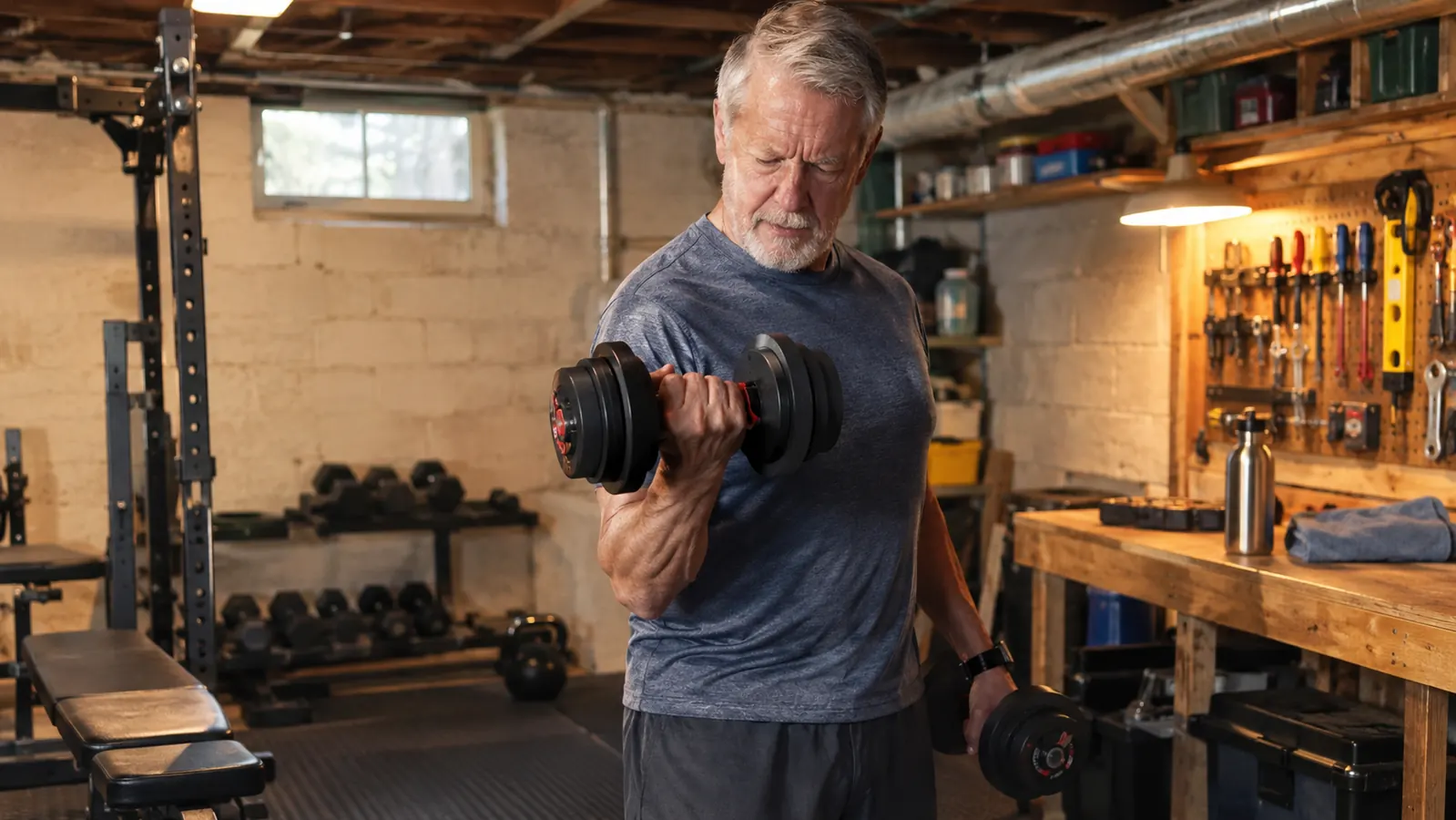
At 61, I couldn't get up off the basement floor without using the workbench. That's the honest truth. A bag of mulch nearly beat me, and playing with the grandkids left me sore for two days. So I started lifting weights at home, three or four mornings a week, and I've kept at it for about five years. This review is about the FEIERDUN DS2 adjustable dumbbells, the set I've been using for months of daily training after 60.
I'm Walt Brenneman, 66, a retired shop teacher from outside Reading, Pennsylvania. My left knee is stiff from decades on concrete floors, and my right shoulder complains overhead. No surgeries, no trainer, no gym membership. Just a corner of my basement with a rubber mat next to the workbench. I bought the FEIERDUN DS2 to replace a pile of mismatched weights, and this is what months of daily use actually look like.
The Quick Verdict
A versatile 5-in-1 set that lets a 60-something lifter do dumbbells, barbell, kettlebell, push-up stand and plate work with one purchase. Not perfect, but very good for home training.
Amazon Check Today's Price →One set for every exercise I still do
The FEIERDUN DS2 replaces five separate pieces of equipment. If you're tired of tripping over mismatched weights, this is the set to check.
Amazon Check Today's Price on Amazon →How I've Used It
I've had the FEIERDUN DS2 for about eight months now, and it's the first thing I reach for on training mornings. My routine is simple: a warm-up, then a mix of exercises that cover my whole body. The set's five functions mean I can do curls with the dumbbells, press them overhead, attach the connector and use the whole thing as a barbell for rows, or work one arm at a time like a kettlebell swing.
The plates are solid iron-sand construction, not loose river sand, so they don't shift around when I'm moving. The handle is a 1-inch rubber grip that fits my hand well, even after my hands get sweaty. The whole set weighs 45 pounds, which is enough for me at my age. I'm not trying to set records. I'm trying to keep getting up off the floor.
Three or four mornings a week, I drag the set onto the rubber mat and work through a routine. Carol, my wife, sometimes joins me with a lighter load. The detachable plates make it easy to drop the weight down for her, then add them back for my sets. That alone has made the set earn its spot in the basement.
A typical Tuesday starts the same way. I pull the set off the shelf under the workbench, set it on the rubber mat, and march in place for a few minutes while I check the plates. Then I start with the lightest setting, a single plate on each side, for shoulder raises, because my right shoulder needs a long warm-up. From there I move to goblet squats holding one dumbbell against my chest, then rows with the connector bar, then curls. The whole thing takes about 35 minutes, and the last exercise is always the one that beat me at 61: getting down on the mat and back up again. I do it five times, slowly, and I don't use the workbench anymore. And I do it all without music or a phone timer. Just the clock on the wall and the sound of the plates clicking together. There's something satisfying about that sound now, because it means I showed up again.
The first week taught me a lesson. I tried to change plates between every set, the way I'd seen younger lifters do in videos, and I spent more time unscrewing and re-screwing than lifting. I also nearly dropped a plate on my foot when I rushed. Now I plan the session so I change the weight at most twice: all my light work first, then one addition of plates, then the heavier exercises. That small change made the set far more practical, and it's the advice I'd give anyone my age who buys an adjustable set.
What the FEIERDUN DS2 Actually Is
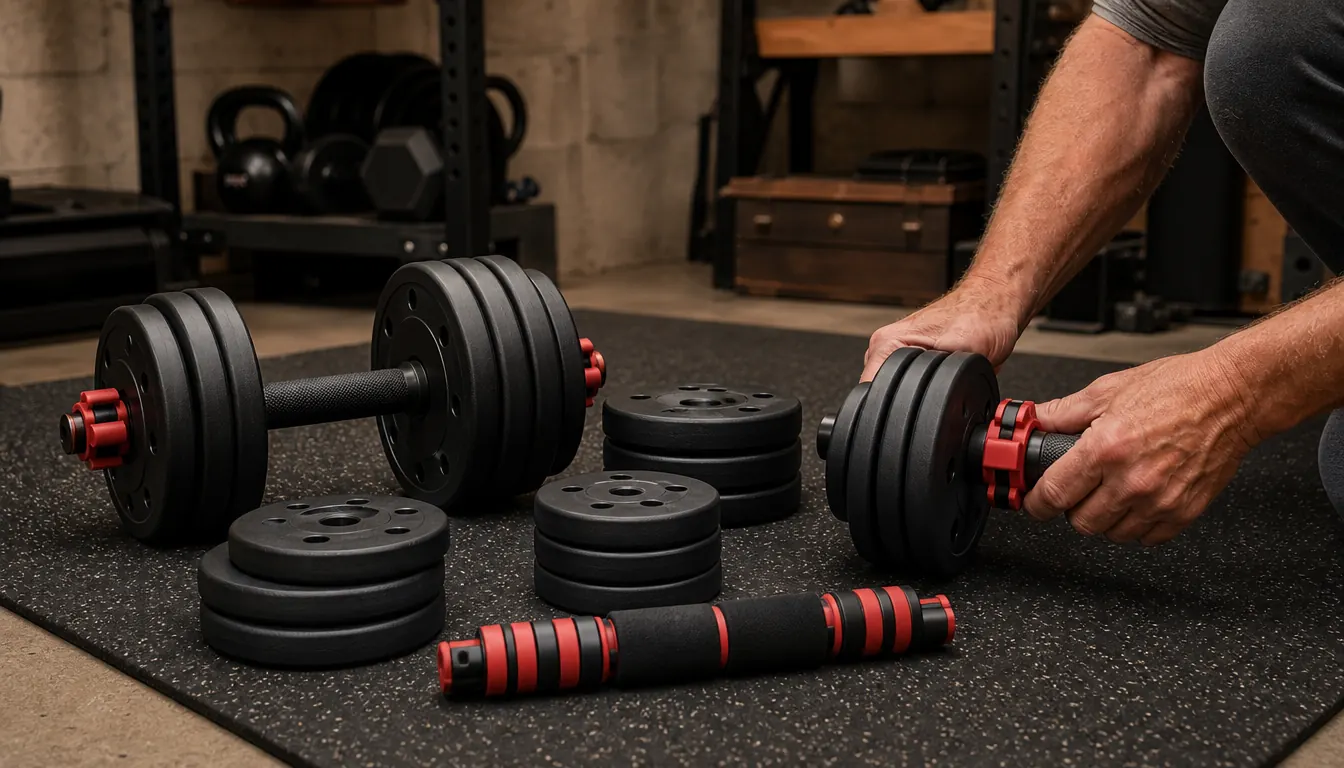
The FEIERDUN DS2 is a 5-in-1 adjustable dumbbell set. The listing calls it a dumbbell, barbell, kettlebell, push-up stand and weight plate set in one. For a guy in his 60s with a corner of the basement and no interest in buying five separate pieces of equipment, that's the whole appeal.
The pieces are detachable, so I can set the weight for each exercise. The adjustable weight range for a single piece covers light work for warm-ups and shoulder exercises, all the way up to heavier loads for legs and rows. I don't need to own a rack of dumbbells anymore. I need one set and a few minutes to change the plates.
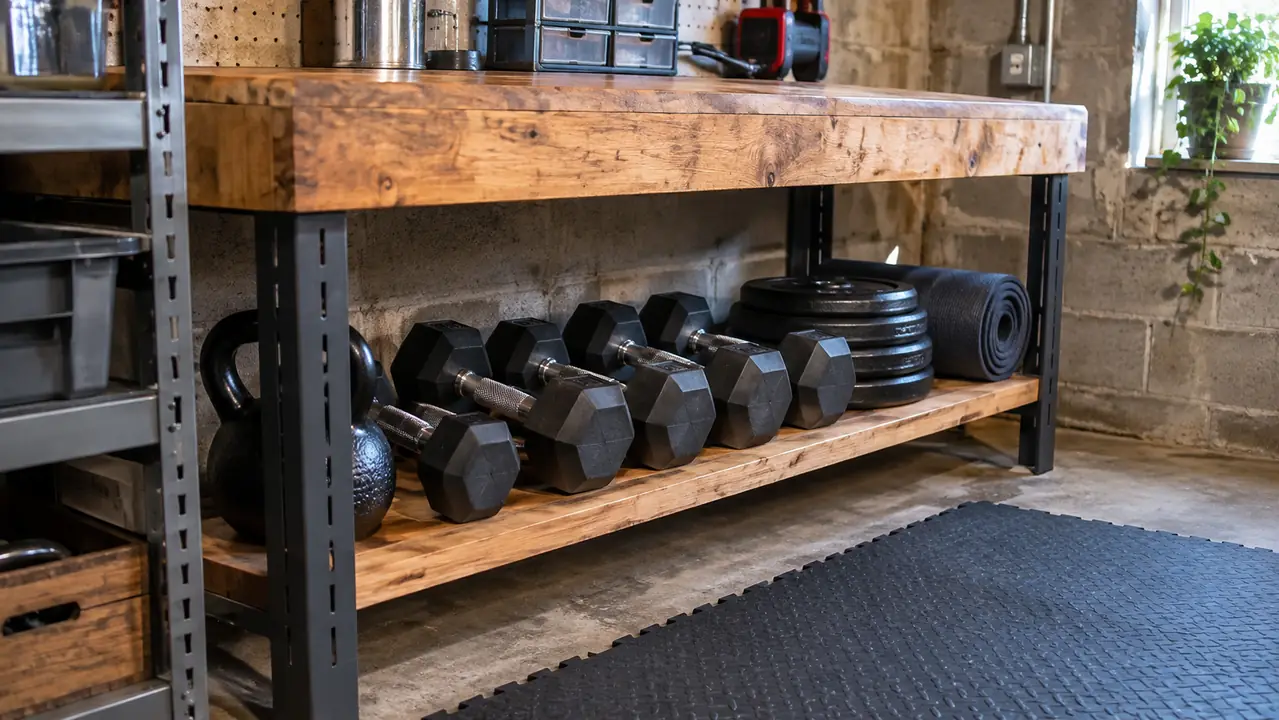
The item weight is 45 pounds and the dimensions are 25.59 inches long by 9.8 inches wide. I mention that because it matters for storage. It fits on a shelf under my workbench, and I can carry it to the mat in one trip. The grip size is medium, and the handle material is rubber, which is the detail that matters most to me. A slippery handle is a dangerous handle.
Let me walk through the five functions, because that part sounded like marketing until I actually used it. As dumbbells, the two handles work like any pair of fixed dumbbells, and that's what I use for curls and shoulder raises. The connector joins the two sides into a barbell, and I use that for bent-over rows and a light overhead press. For kettlebell work, I hold one side by the handle and swing it with one arm, which gets my heart rate up faster than any curl. The push-up stands let me keep my wrists straight, and Carol uses those more than I do because she had wrist trouble years ago. The plates themselves come off and work as individual weight plates, which I use for a few isolation moves where a full dumbbell is too bulky.
The adjustable range matters more than I expected. On a light day I use a single plate per side for lateral raises, maybe 10 to 12 repetitions. On a heavier day I load both sides for rows and squats. The detachable design means I'm not stuck with one weight for the whole session, which was exactly my problem with the three pairs of fixed dumbbells I owned before. I had a light pair, a medium pair, and a heavy pair, and I still didn't have the right weight for half the exercises I wanted to do. This set covers the whole range in one box.
How It Holds Up Over Months of Use
After eight months, the FEIERDUN DS2 still looks and works the way it did on day one. The iron-sand plates haven't cracked or chipped. The rubber grips haven't peeled. The connector still locks in place the same way it did in the first week. That's the test that matters for home equipment: does it survive being used regularly by someone who isn't gentle with it?
I will say this: the set is not a magic fix for aging. It's a tool. The tool works, but I still have a stiff knee in the morning and my shoulder still complains if I push overhead too hard. What the FEIERDUN DS2 does is make it easy for me to do the work anyway. The plates change fast, the grip is comfortable, and the set is solid enough that I trust it with a heavy row.
There was one moment in month three when I thought I'd found a problem. I was doing rows with the connector bar, and I felt a small click on the left side at the top of the movement. I stopped, set the bar down, and took the whole thing apart right there on the mat. What I found was my own mistake: I hadn't tightened the locking collar all the way when I'd changed plates the session before. I put it back together, made sure both collars were snug, and the click never came back. That was the moment I stopped treating the set as something fragile and started trusting it. Since then, checking the collars has become part of my pre-lift routine, right up there with the warm-up.
I also check the plates themselves every few weeks. The iron-sand construction means there's no loose fill inside, so there's nothing to settle or pack down over time. The plates are integrally molded, which is a plain way of saying each one is a single solid piece. After eight months of being dragged on and off the mat, dropped from a few inches when I get careless, and stacked on the shelf, they still feel as dense as they did in the first week. The rubber grips have a little polish from my hands now, but no peeling and no cracks. For a set that lives in a damp basement corner, that's a good report.
Eight months in, the FEIERDUN DS2 still locks together like it did on day one. That's the test that matters for home equipment.
Safety Notes for Lifters Over 60
Before you buy anything, check with your doctor. I'm not a medical professional and I won't pretend to be one. What I can tell you is what works for me: I warm up before every session, I start with a lighter weight than I think I need, and I never train through sharp pain.
The FEIERDUN DS2's detachable design means you should double-check that the plates are locked before you lift. I make it a habit to give each side a quick tug before I start a set. It takes two seconds and it's saved me from a plate sliding mid-lift more than once. The rubber grip helps here too, because I can hold the handle firmly without death-gripping it.
I also use the set's push-up stand function to keep my wrists in a neutral position. That's been a small change with a big payoff for my shoulder. And when I use the connector as a barbell, I keep the weight modest and focus on form. At 66, the goal is to still be lifting at 76, not to impress anyone today.
The other habit I developed is writing things down. I keep a spiral notebook on the shelf above the workbench, and after each session I jot the date, the exercises, and how many repetitions I managed. It's not fancy software. It's a plain notebook. But it's how I noticed that my knee bothered me less in month six than in month two, and it's how I know I've added two repetitions to my rows since March. That record also catches problems early. If an exercise starts feeling harder instead of easier, I know to back off or check my form before I hurt myself. I look back through it every few months, and the early pages remind me how far I've come. That's worth more than any number on a scale.
One more thing about the connector bar. The first time I used it as a barbell, I loaded both sides and felt the whole assembly flex a little under the load. I took that as a clear sign to keep the weight modest for barbell-style work. The set is built for home training, not for a powerlifting meet, and that's fine with me. I use the connector for rows and light presses, and I save the heavier work for exercises where I'm holding a dumbbell in each hand and I have more control over the movement.
Pros and Cons
What I Liked
- Five functions in one set: dumbbells, barbell, kettlebells, push-up stand and plates
- Solid iron-sand plates that don't shift or crack
- Comfortable 1-inch rubber grip with a medium fit
- Detachable plates make it easy to change weight between sets
- Compact enough to store under a workbench
Where It Falls Short
- At 45 pounds, it's not enough for serious powerlifters
- Swapping plates takes a few minutes, so it's slower than a rack of fixed dumbbells
- The plastic material on some parts feels less premium than the iron-sand plates
- The connector can take a little fiddling to line up perfectly
Who This Is For
The FEIERDUN DS2 is for people like me: adults in their 60s who want to strength train at home without turning the spare room into a gym. If you're starting out, or coming back after a long break, this set gives you everything you need to build a full-body routine with one purchase. It's also great for anyone with limited space, because the whole thing stores in a small footprint.
It's for the person who wants to do a little bit of everything. Some days I want dumbbell curls, some days I want a barbell row, some days I want to do push-ups with my hands on the stands. The FEIERDUN DS2 lets me switch without owning five different tools. That's the convenience that keeps me consistent, and consistency is what actually builds strength after 60.
Who Should Skip It
If you're a competitive lifter or you're training for serious strength gains, this set probably isn't for you. The 45-pound total weight is a limit, and the time it takes to swap plates will frustrate you if you're used to grabbing a fixed dumbbell and going. Serious lifters should look at a full rack of dumbbells or a dedicated barbell setup.
It's also not for someone who wants a completely friction-free experience. The detachable plates are convenient, but they're not as instant as a dial-based adjustable dumbbell. If you hate the idea of taking two minutes to change the weight, you'll find that annoying. And if you're looking for a piece of equipment that does one thing perfectly, rather than five things well, this set trades a little polish for a lot of versatility.
Months of use, and I still reach for it first
If you're over 60 and want one set for full-body strength training at home, the FEIERDUN DS2 is worth a hard look. Check today's price on Amazon.
Amazon Check Today's Price on Amazon →