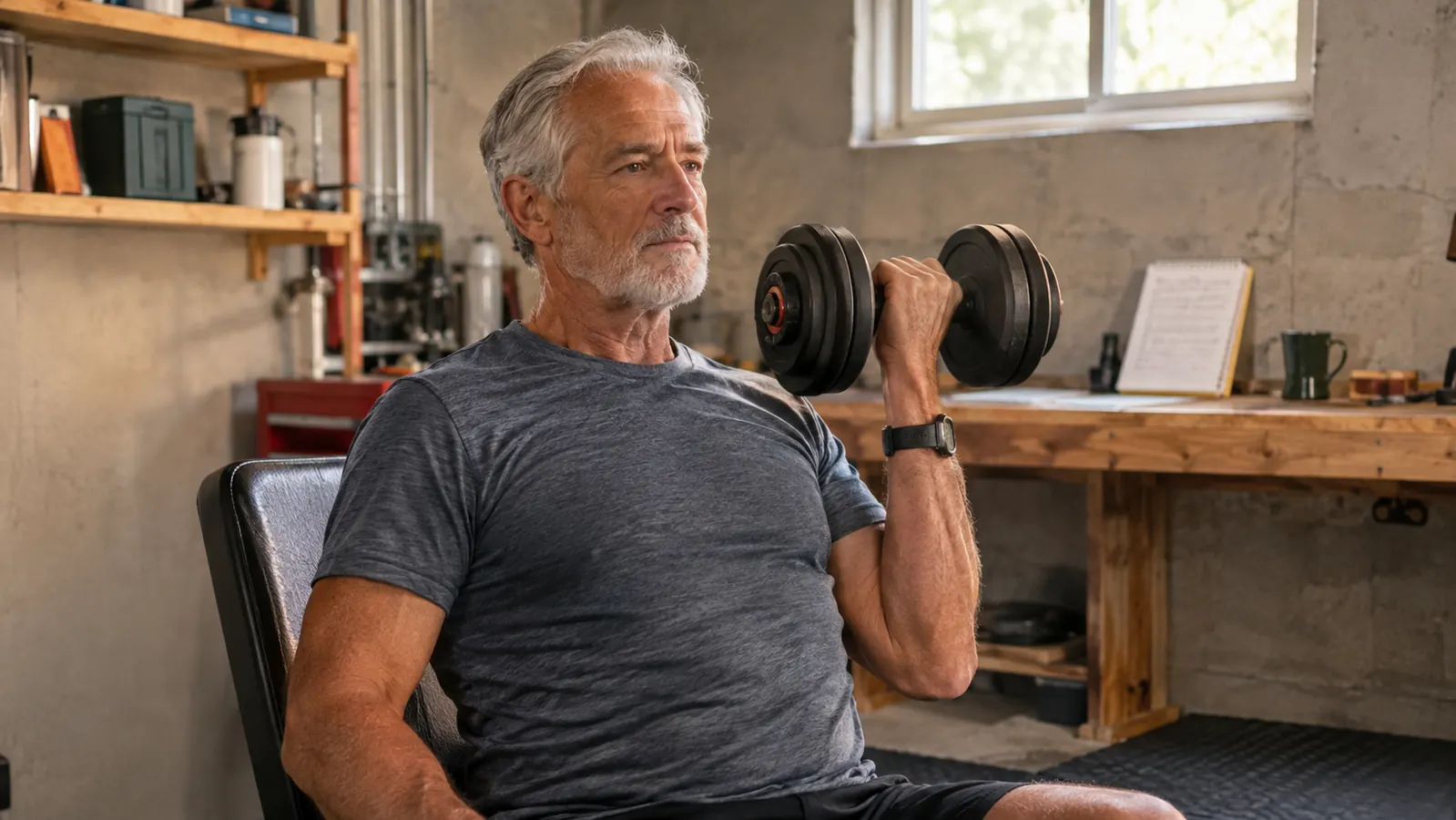
The summer I turned 61, I could not lift a bag of mulch out of the trunk of the car. I stood there with my hands on my knees, doing the math on whether I could roll it to the edge and let it drop. That was the moment I knew something had to change. I had spent thirty years as a shop teacher, which means I had spent thirty years lifting, carrying, and bending without ever thinking about it. Then I retired, and my body quietly went soft. Getting up off the floor after playing with my grandkids took a hand on the coffee table and a grunt. Carol pretended not to watch, which was worse than if she had said something. That fall I cleared a corner of the basement, put down a rubber mat next to the workbench, and started lifting weights at home for the first time in my life. I am sixty-six now, I still train three or four mornings a week, and I can get off the floor without holding onto anything. This article is how I would walk a friend through starting the same way, with the FEIERDUN DS2 adjustable dumbbell set that has been in my corner for the last few years.
Let me be clear about what this article is not. It is not medical advice, and I am not a personal trainer. I am a retired shop teacher with a stiff left knee from decades on concrete floors and a right shoulder that complains when I reach overhead. I have no gym membership and no coach. What I have is five years of showing up in my own basement, three or four mornings a week, and figuring out what works. If you are in your sixties and have not lifted in years, the first step is a conversation with your doctor. The second step is the practical part: setting up a space, learning the movements, and building a habit that sticks. That is what I will walk you through here.
The five-in-one set that fits in a basement corner
The FEIERDUN DS2 replaces dumbbells, kettlebells, a barbell, push-up stands, and weight plates in one compact set. The plates are detachable, so you can start light and add weight as you get stronger, and the whole thing tucks next to a workbench. It is the set I reach for three mornings a week.
Amazon Check Today's Price on Amazon →Step 1: Talk to your doctor and take an honest look at where you are
Before I picked up a single plate, I sat down with my doctor and told him what I wanted to do. I wanted to start lifting weights at home, I had a left knee that had been stiff for years, and my right shoulder did not like reaching overhead. He checked me over, told me to start light, move slowly, and stop anything that caused sharp pain. That conversation matters more than any piece of equipment you will buy. At sixty, your body does not bounce back the way it did at forty, and the smartest thing you can do is know what you are working with before you start asking it to do hard things.
Once you have the all-clear, take an honest inventory. Can you get up from a kitchen chair without using your hands? Can you carry a bag of groceries up a flight of stairs? Can you get down onto the floor and back up again? Write down the things that are hard. That list is your starting point, and it is the thing you will measure against in six months. I wrote 'get off the floor without the coffee table' on a scrap of paper and taped it to my workbench. It stayed there for a year, and I can tell you the exact morning I took it down.
Do not compare yourself to what you could do at thirty, and do not compare yourself to the person in the workout video. Compare yourself to last month. That is the only comparison that will keep you coming back, and it is the only one that is fair.
Step 2: Set up a corner you will actually use
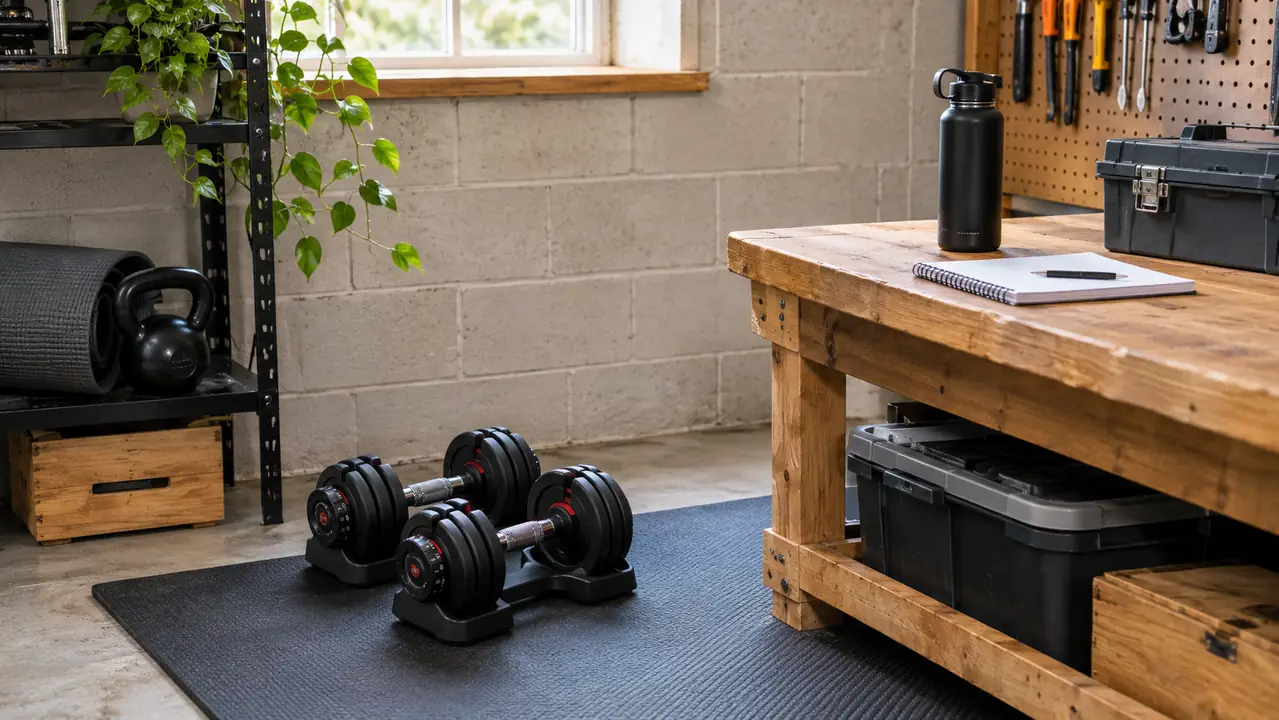
You do not need a garage gym, a membership, or a rack of equipment. I train in a corner of my basement on a rubber mat, with my workbench a few feet away and an old shelf unit holding the plates when they are not in use. The FEIERDUN DS2 is built for exactly this kind of space. The set measures 25.59 inches long and 9.8 inches wide, and the listed item weight is 45 pounds, which means I can pick the whole thing up and move it when I need the floor for a project. If you have a corner of a bedroom, a porch, or a basement, you have enough room.
Put something soft under your feet. A rubber mat, a folded exercise mat, or an old carpet remnant all work. You will be standing, kneeling, and sitting during your sessions, and a hard floor is unforgiving on a stiff knee. Keep a sturdy chair nearby for seated movements and for resting between sets. Put a water bottle and a towel within arm's reach. That is the entire setup. Nothing else is required, and that simplicity is what makes it possible to keep doing it.
One thing I learned the hard way: keep the set where you can see it. When the dumbbells sit in the corner of the living room, I train. When they are buried in the garage behind the lawnmower, I do not. Visibility is half the battle. Carol rolls her eyes at this, but she also trains with me now, so I think it worked.
Step 3: Learn the five functions before you lift anything heavy
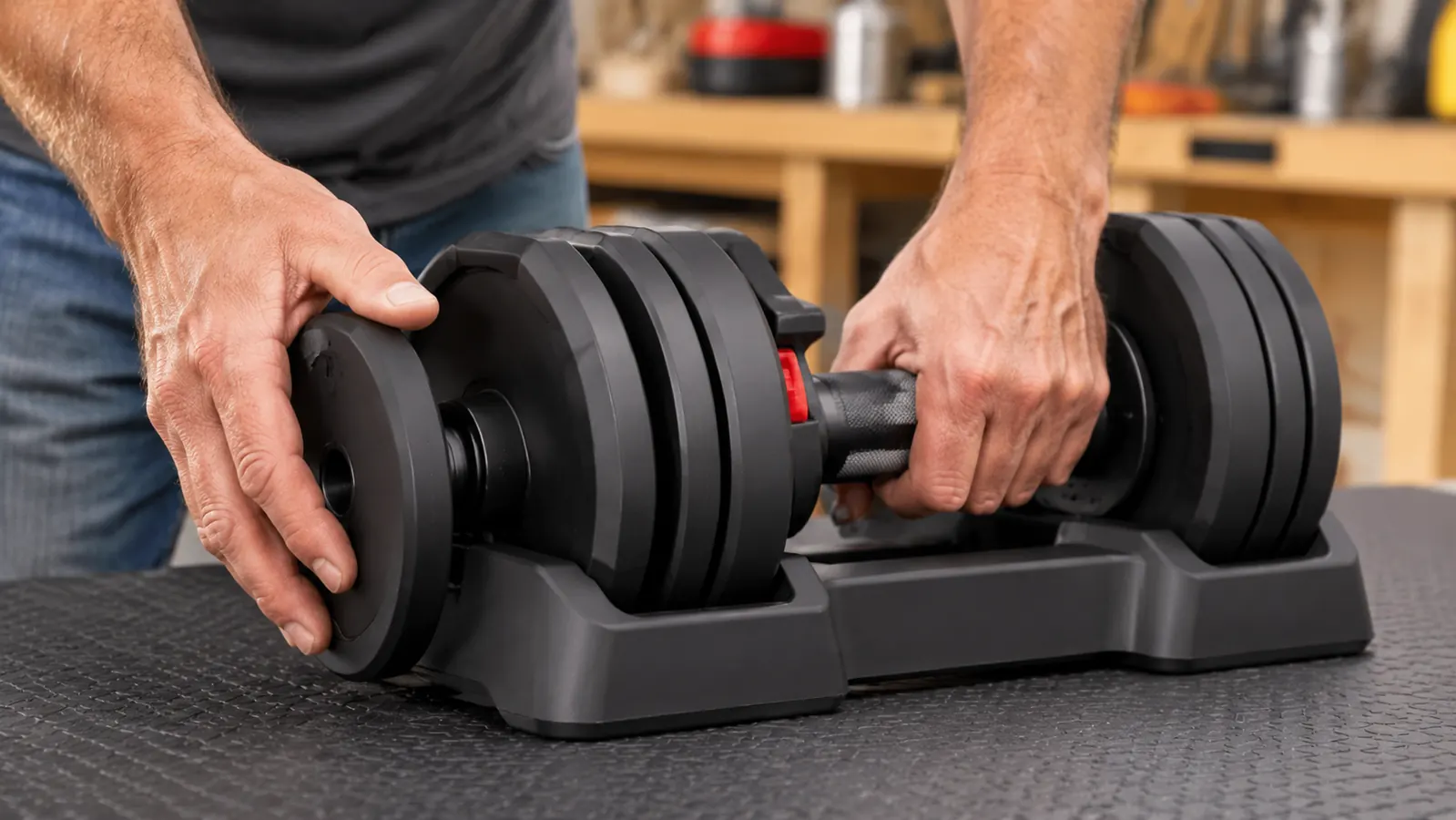
The reason I chose the FEIERDUN DS2 is that one set replaces five pieces of equipment. It works as dumbbells, kettlebells, a barbell, push-up stands, and weight plates. The plates are detachable, so you adjust the weight by adding or removing them, and they are molded with high-density iron sand, not loose sand that shifts around inside. The handles are rubber with a 1 inch diameter and a medium grip, which fits my hands well and does not slip when my palms get sweaty. I have never needed anything else in five years.
Take an afternoon, before your first real session, to take the set apart and put it back together a few times. Click the plates off, click them on, attach the connector bar to make the barbell, and try the push-up stands. Knowing how the pieces go together when you are not tired means you will not be fumbling with them at six in the morning. It also means the setup never feels like a chore, and a setup that feels like a chore is the fastest way to talk yourself out of a workout.
Start with the lightest weight that still lets you do the movement cleanly. For most beginners over sixty, that is the smallest plate combination. You are not trying to impress anyone. You are trying to build a habit you can still be doing five years from now. I started embarrassingly light, and I am glad I did. My knee and my shoulder are both still working, and I have not had a single injury in five years of training at home. That is the whole point.
Step 4: Build a simple routine you can do three mornings a week
My week looks like this: Monday, Wednesday, and Friday mornings, twenty-five to thirty minutes in the basement. I do five movements, and I have kept them the same for years because they work. A seated shoulder press with the dumbbells. A bent-over row. A goblet squat, holding one dumbbell at my chest. A floor press, lying on the mat. And a farmer's carry, walking the length of the basement with a dumbbell in each hand. That covers the whole body, which is what this set is designed for, and the whole session fits in half an hour.
For each movement, start with two sets of eight to ten repetitions. Rest as long as you need between sets, and stop when your form starts to fall apart. The goal is not to exhaust yourself. The goal is to be a little stronger next month than you are this month. If you have never done a goblet squat, practice the movement with just a plate before you add the handle. My left knee appreciated that patience, and so did my pride.
Carol sometimes trains with me, and I have found that having a partner helps. Not because we spot each other, but because we hold each other to the schedule. On the mornings I would rather stay in bed, she is already in the basement, so I go down too. If you can find a friend or a spouse to train alongside, even once a week, you are more likely to stick with it. If you cannot, no problem. I trained alone for the first two years.
Step 5: Progress slowly and write everything down
Here is the part nobody tells you about getting stronger at sixty: it is slow, and that is fine. You will not add weight every week the way a twenty-five-year-old might. You will add a repetition here and a set there, and every once in a while you will move up to the next plate and it will feel heavy for two weeks and then it will feel normal. That is progress. Write it down. I keep a spiral notebook on the workbench and I record every session: the date, the movements, the weight, and how it felt. It takes ninety seconds.
The notebook does two things. It shows you, in black and white, that you are improving, which matters on the days you feel old and creaky. And it catches problems early. If my right shoulder starts complaining at a certain weight, I can look back and see exactly when it started and what I changed. When you are training alone, the notebook is your coach, and it is the only coach that never misses a session.
When you do move up, move up by the smallest step the set allows. The FEIERDUN plates are detachable, so you can add a single plate at a time instead of jumping up by a big chunk. That fine control is one of the reasons adjustable dumbbells suit older lifters. You are never forced to make a jump your joints are not ready for. You set the pace, and the pace is always small.
What Else Helps
The dumbbells are only part of it. What made the difference for me was the stuff around the edges. Walking. I take a twenty-minute walk most days, and it keeps my stiff knee from stiffening up completely. Sleep. I go to bed at a reasonable hour and I wake up at the same time, even on weekends. Food. I am not a nutritionist, but I eat more protein than I used to and I drink water instead of soda. None of this is dramatic. It is just steady, and steady is what wins at our age.
Warm up before you lift. I do five minutes of marching in place and arm circles before I touch a dumbbell. It is boring, but it is the difference between a good session and a morning where my shoulder reminds me I am sixty-six. And if a movement hurts, stop doing it. There are a hundred other exercises that work the same muscle. Pain is information, not a medal, and nobody is handing out medals for training through an injury.
I started embarrassingly light, and I am glad I did. Five years later I still train three mornings a week, and I have not had a single injury.
Start with a set that grows with you
The FEIERDUN DS2 adjusts from light to heavy as you get stronger, and it replaces five pieces of equipment in one corner of your home. It is the set I reach for three mornings a week, and the reason I can still get off the floor after playing with my grandkids. Check today's price on Amazon and see if it fits your corner.
Amazon Check Today's Price on Amazon →