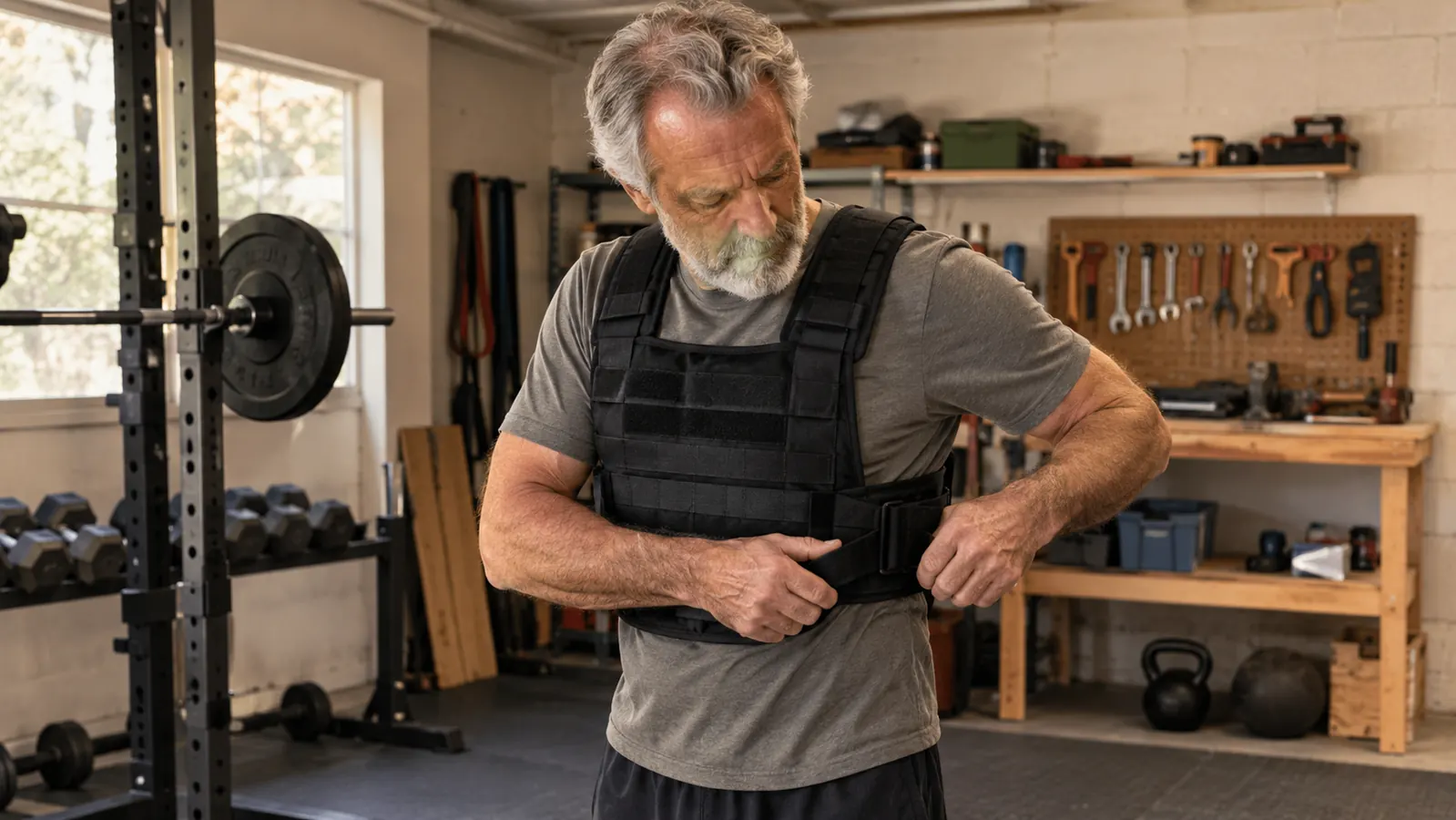
At 66, I keep my weights in a corner of the basement on a rubber mat, right next to the workbench where I spent thirty years building shop projects. No gym membership, no trainer, just a few pieces of gear I trust and a routine I have kept up for about five years, three or four mornings a week. I started strength training at home after a morning when I could not lift a bag of mulch into the trunk of the car, and then a few weeks later I got down on the floor to play with my grandkids and could not get back up without holding on to the couch. That was the wake-up call. I figured I needed both a ZELUS weighted vest and a set of ankle weights. I bought the ankle weights first because they were simpler and I could use them sitting down. I wore them for about three weeks, and by the second week my stiff left knee, the one that spent decades on concrete shop floors, was aching in a way I did not like. So I set them aside and ordered the ZELUS weighted vest instead. Now that I have trained with both for a while, I can give you the honest answer: for most people in their 60s, the ZELUS weighted vest earns its place in the home gym first, and ankle weights are an occasional tool. Carol watched the whole experiment and said I looked like a man trying to fix a hinge with a hammer. She was right.
This is not a case of one being bad and the other being good. They load your body differently, they fit different exercises, and they carry different risks for stiff knees and cranky shoulders. The ankle weights hang right below the knee, so every step and every leg lift pulls on that joint. The vest spreads the load across your torso, close to your center of mass, which is where your body is built to carry weight. Think of it this way: a vest makes the work you already do harder in a good way. Ankle weights add a new kind of work that your joints have to manage. Here is the short version before I get into the details: if you want one piece of gear that adds resistance to walks, bodyweight squats, step-ups and everyday chores like carrying firewood up from the basement, buy the ZELUS weighted vest. If your doctor or physical therapist gives you specific exercises to isolate your lower legs, ankle weights still have a job. Most people do not need both. I kept both, but the vest is the one that hangs on the hook by the basement door, and the ankle weights live in a drawer until I need them for a specific exercise.
| ZELUS Weighted Vest | Ankle Weights | |
|---|---|---|
| How the load sits | Distributed across the torso, close to your center of mass | Concentrated at the ankles, pulling on the knee joint |
| Best for | Walks, step-ups, squats, carries, daily chores | Isolated leg lifts and rehab-style moves under guidance |
| Lower-leg isolation | Not built for working one leg at a time | The right tool for seated leg lifts and PT exercises |
| Knee comfort | Load stays off the knees; my stiff left knee handles it well | Hangs below the knee and can tug at it during leg lifts |
| Adjustability | Buckle straps fit a range of torsos, sizes from 6 to 30 lb | Usually sold in fixed pairs, hard to fine-tune |
| Range of loads | One vest covers 6 to 30 lb as you get stronger | Need several pairs to cover the same range |
| Spine loading | Adds load to the torso, which some backs may not like | Keeps the spine out of it entirely |
| Safety for seniors | Weight rides high and stable, hands stay free for balance | Adds leverage at the ankle, which can challenge balance |
Where the ZELUS Weighted Vest Wins
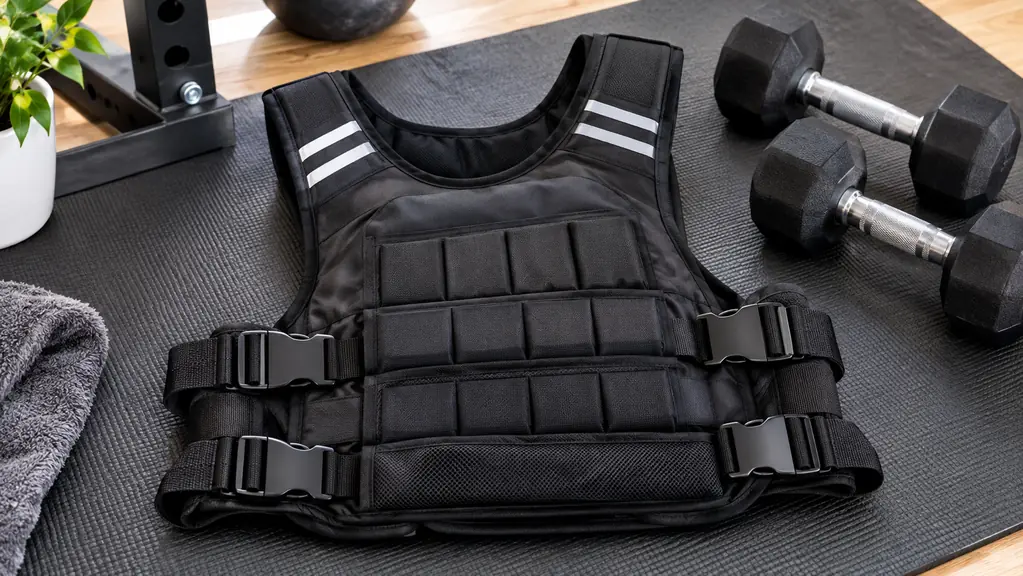
The ZELUS weighted vest wins because it adds resistance without changing how you move. The first morning I wore it, I walked the half-mile loop past the old stone church and back, the same route I had walked for years. I started with the 8 lb size, and by the third block my legs knew it, but my balance never changed. My hands were free, my stride was normal, and my left knee, the one that complains when I carry a heavy toolbox at my side, did not say a word. That is the whole argument for a vest in one walk. The weight sits across your torso, close to where your body naturally carries its own weight, so you move the way you normally move, just with more effort. I use it for step-ups onto the bottom step of the basement stairs, for slow bodyweight squats in front of the workbench, and for the ten-minute walk to the mailbox and back on days when I am not doing a full session. One morning in November, I wore it for a set of slow squats in front of the workbench, ten reps, and my legs were shaking by the last one. The vest did not make the movement awkward. It just made it honest. The vest turns all of those ordinary moments into training without making me think about it. It also keeps the load off my hands and my right shoulder, which complains on overhead moves, so I can add resistance without aggravating the joints that already bother me.
The vest is also the most adjustable piece of gear I own. The buckle straps fit a range of torsos, so Carol can borrow it even though she is a good bit smaller than me, and the vest comes in sizes from 6 to 30 lb, so you can start light and work up as you get stronger. I started at 8 lb and moved to 12 lb after about six weeks, when 8 lb started to feel like my regular t-shirt. I thought about moving up to 16 lb, but 12 lb still gives me what I need, and I would rather add reps than weight at my age. The arm pockets hold my keys and my phone on a walk, which sounds like a small thing until you have carried keys in your fist for a mile and spent the whole walk wishing you had a pocket. The reflective stripes are a real feature, not a gimmick, because I walk along a road with no shoulder and I want drivers to see me in the early morning light. For a home gym for seniors, the vest does the job of several different tools in one piece of gear. It takes about ten seconds to put on, it does not have batteries, and it does not need to be charged or updated. That matters to a retired shop teacher who likes his tools simple and dependable.
Where Ankle Weights Win
I am not here to tell you ankle weights are useless, because they are not. They win in one specific situation: when you need to isolate the lower leg for targeted moves like seated leg extensions, side-lying leg lifts, or balance work that a physical therapist has given you. A few years back, when my knee was at its grumpiest, the doctor suggested I strengthen the muscles around it without loading my spine. A pair of ankle weights let me do exactly that. I would sit on the edge of the basement steps with the weights strapped around my ankles and do slow leg extensions, ten reps per leg, while Carol counted out loud and told me I was going too fast. The doctor called them hip abduction exercises, but I just called them the ones that made my hip feel better. It was not glamorous, but it helped. The weights let me work one leg at a time, which the vest cannot do. If you need to fix an imbalance between your left and right sides, or you are doing rehab after a knee or hip issue, ankle weights are the right tool, and no vest is going to replace them for that job.
But here is the tradeoff, and it is a serious one for people our age. Ankle weights concentrate the load at the very end of your leg, which increases the leverage on the knee joint. During a brisk walk, that extra weight at the ankle can make your knee work harder than the same weight on your torso would. I learned this the hard way during those three weeks I wore them on walks. By the end of the second week, my left knee ached every evening, and I could feel the pull on every step, especially on the downhill stretch past the church. Carol noticed the limp before I did, which is how I knew it was not in my head. I stopped wearing them for walks and switched to the vest, and the ache went away within a few days. For a person in their 60s with an already stiff knee, that is worth taking seriously. I would not wear ankle weights for walking or for any move where I am on my feet for a long stretch. I would only use them seated or lying down, and only if my doctor cleared me for that kind of loading. If you have any doubt about your knees, ask your doctor before you strap weight to your ankles and go for a walk.
The vest I reach for three mornings a week
The ZELUS weighted vest is the piece I keep on the hook by the basement door. Check today's price on Amazon and see which size fits your routine.
Amazon Check Today's Price on Amazon →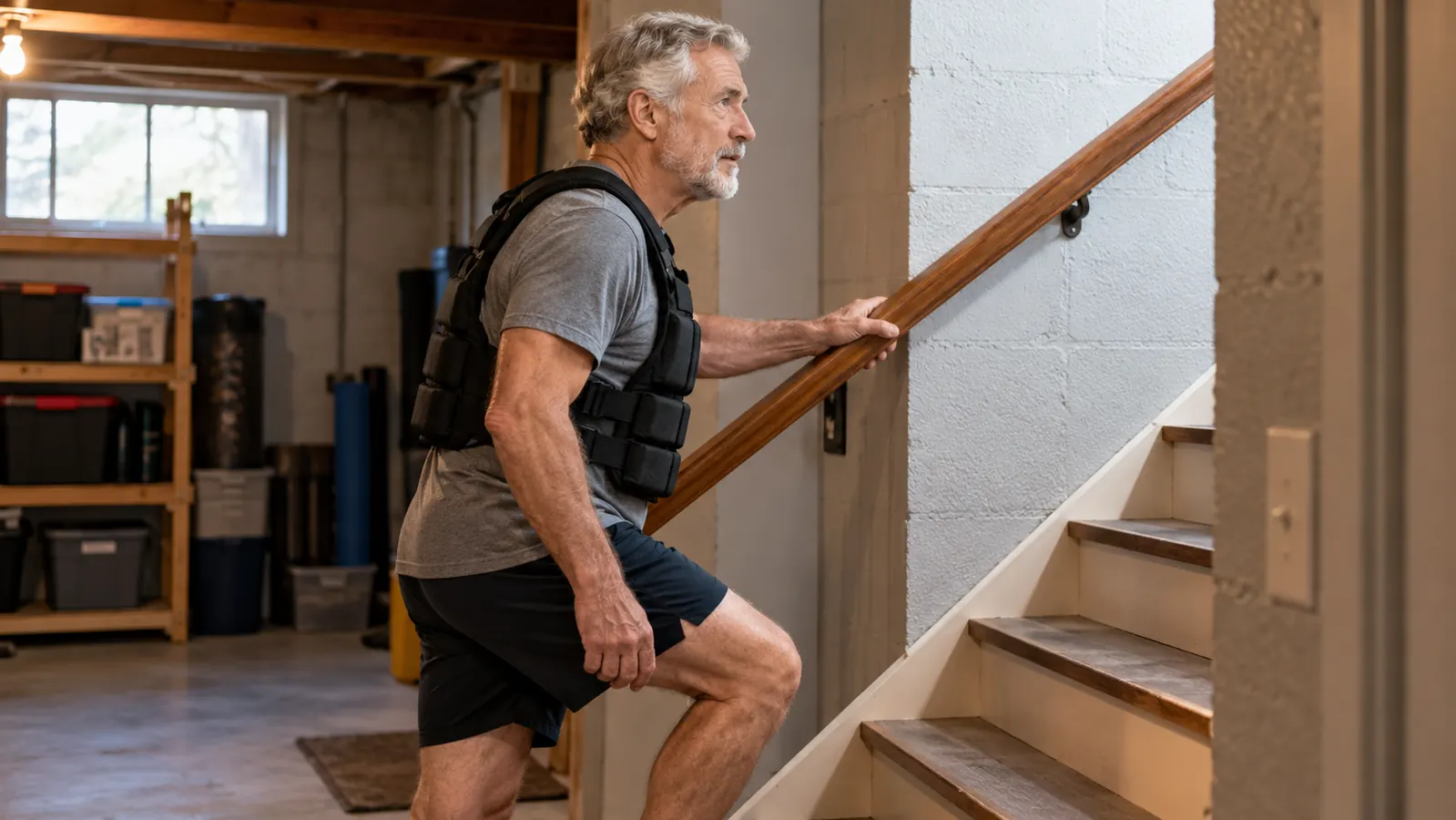
Who Should Buy Which
Buy the ZELUS weighted vest if you want to make daily life feel easier. You will wear it for walks, for stairs, for squats, for carrying firewood, for anything where you want your body to work a little harder while you move the way you normally move. I wear mine three or four mornings a week, and I notice the difference most on the days I do not wear it, when the stairs feel lighter than they should. It is the better fit for a home gym for seniors because it is one piece of gear, it adjusts as you get stronger, and it keeps the load off your knees. Carol tried it on a walk with me one Saturday morning and said the weight felt steadier than the ankle weights she had borrowed from a neighbor, and she is not easy to impress. She has started using it herself on her morning walks, which tells you more than anything I could say. My rule is simple: if I am going to add weight to my body, I want it where my body is built to carry it. If you are going to buy one piece of gear to make your daily movement harder in a good way, this is the one.
Buy ankle weights instead if a doctor or physical therapist has given you specific exercises to isolate your lower legs, and only if they have cleared you for that kind of loading. They are a tool for a specific job, like a coping saw in a shop full of power tools. If you are not sure which camp you are in, start with the vest. It is the safer, more versatile choice for most people over 60, and it will not sit in a drawer after the first week. That is exactly what happened to my ankle weights: they have a job, but it is a small one, and the vest is the tool I reach for. Before you start any new program, check with your doctor, especially if you have a history of knee, hip or back trouble. And if you do buy a vest, start with a lighter size and give your body a few weeks to adjust. There is no prize for rushing. There is only next year, and the year after that. The goal is to still be training next year, not to impress anyone next week.
My pick for a senior home gym
The ZELUS weighted vest is the piece I reach for when I want to make a walk or a set of squats work harder. See today's price on Amazon and decide for yourself.
Amazon Check Today's Price on Amazon →