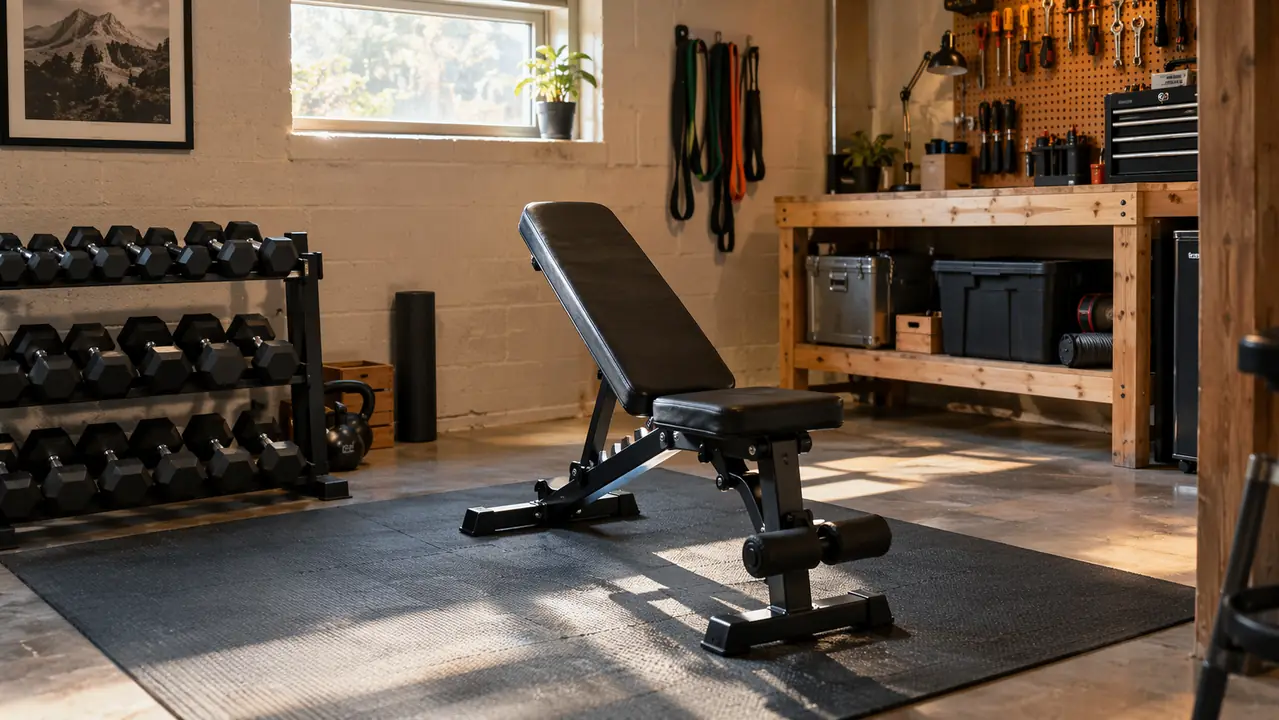
I did not buy my first weight bench because I wanted to look like someone from a magazine. I bought it because at 61 I tried to lift a bag of mulch out of the trunk of the car and my back said no. Then I got down on the floor to play with my grandkids and could not get back up without using the coffee table. That was the moment. My doctor said strength training would help, so I cleared a corner of the basement, put down a rubber mat next to my workbench, and started lifting three or four mornings a week. That was about five years ago. This review is about the FLYBIRD adjustable weight bench that has been in that corner for the last several months, and what I wish someone had told me before I ordered it.
Most reviews of this bench start with the numbers. The FLYBIRD is rated for 750 pounds, it weighs 23 pounds itself, and it is built to the 17.38-inch IPF competition height. Those are all real, and I will get to them. But the things nobody tells you are smaller and more practical. The adjustment bar needs a firm pull before it loosens up. The pad is firm in a way that took me a week to appreciate. And the bench is light enough that you will actually move it, which is both the best and the most annoying thing about it. Let me walk you through all of it.
The Quick Verdict
A stable, adjustable bench that suits a home lifter in his 60s. Not perfect, but I would buy it again.
Amazon Check Today's Price →The bench I reach for every morning
If you are tired of fighting a wobbly bench or doing everything on the floor, this is the one I keep coming back to. See what it costs today.
Amazon Check Today's Price on Amazon →How I've Used It
I train in a corner of the basement on a rubber mat next to my workbench, with a set of dumbbells on a rack against the wall. Three or four mornings a week, I do the same circuit: dumbbell chest press, seated rows, shoulder work that does not make my right shoulder angry, and sit-ups with my feet under the leg holder. Carol, my wife, uses it too, mostly for lighter work and seated exercises. Between the two of us, the bench gets used five or six days a week.
The first thing I noticed was the height. At 17.38 inches, it is the same height as the benches used in IPF competition. For me, that means I do not have to fold myself down onto it or heave myself off it. With a stiff left knee from years on concrete shop floors, that matters more than I expected. I can sit down like a person, not like a folding chair.
The second thing I noticed was the stability. The frame is alloy steel with reinforced triangle supports, and the 750-pound rating is on the listing. I do not load anywhere near that. I am a 66-year-old retired shop teacher pressing dumbbells, not a powerlifter. But the rating tells you something useful anyway: the frame does not flex, and the bench does not rock when I sit down or move around. At the weights I actually use, it might as well be bolted to the floor.
What Nobody Tells You Before You Buy
Assembly is worth a mention because it is the first thing you will do. The bench arrived in a box, and I put it together one evening in the basement. The instructions were clear enough for a retired shop teacher who has assembled a lot of things in his life, and I did not need any help. I will not pretend it took five minutes, because it did not. But it was not a project, either. It was a reasonable evening task, and the tools I needed were already in my toolbox.
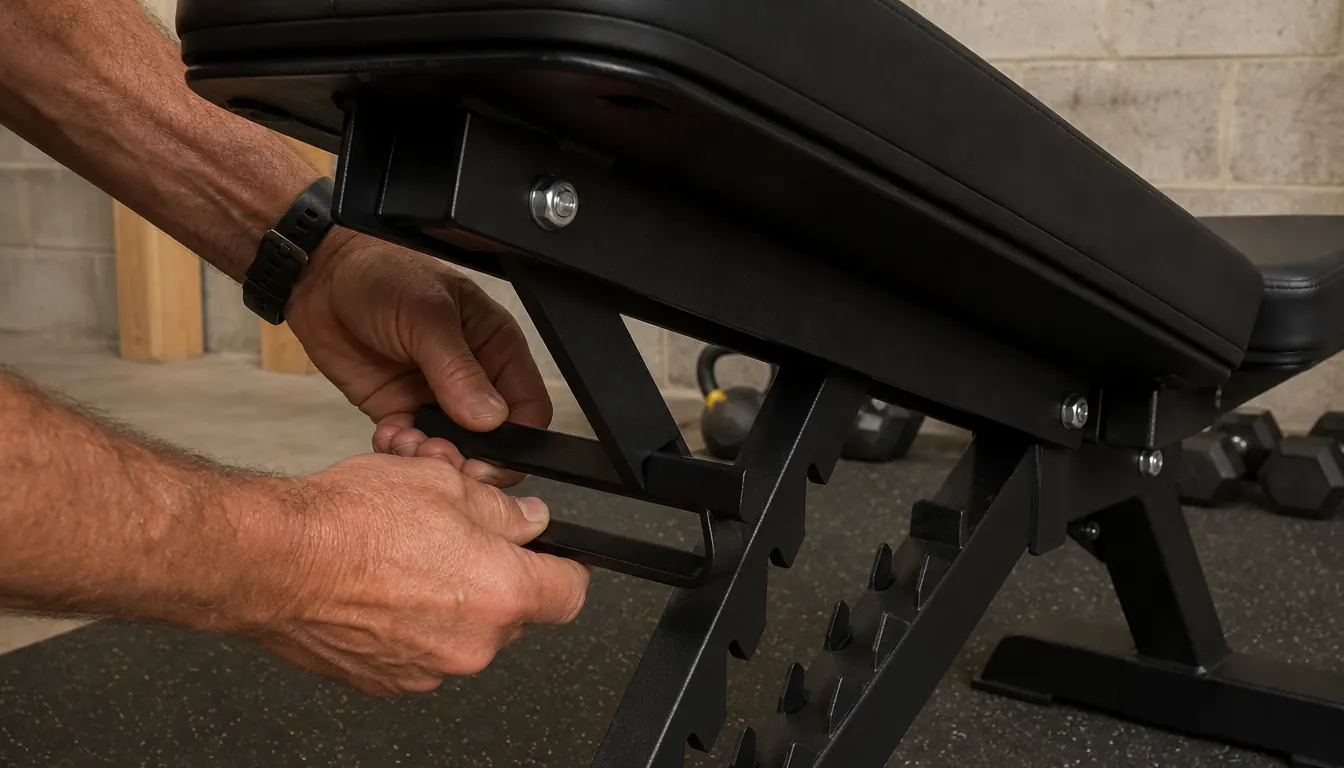
Here is the honest part. The adjustment system works the way the listing says: pull the support bar, and you get 8 backrest positions, 4 seat positions, and 3 leg holder positions. That sounds simple, and it is. But the first few times, that bar needs a firm pull. It took me a couple of tries to find the right angle, and Carol had to ask me to show her how. After a week it became natural, but do not expect it to glide the first time you touch it.
The pad is another thing nobody mentions. The surface is sweat-proof leather, which means it wipes clean in about ten seconds. I appreciate that in a basement in July. But the padding itself is firm. The first week, I noticed it. By the second week, I understood why: a firm pad keeps you stable when you are pressing, and it does not bottom out. If you want a plush, living-room-furniture bench, this is not that. If you want a bench that does not squish under you, this is exactly that.
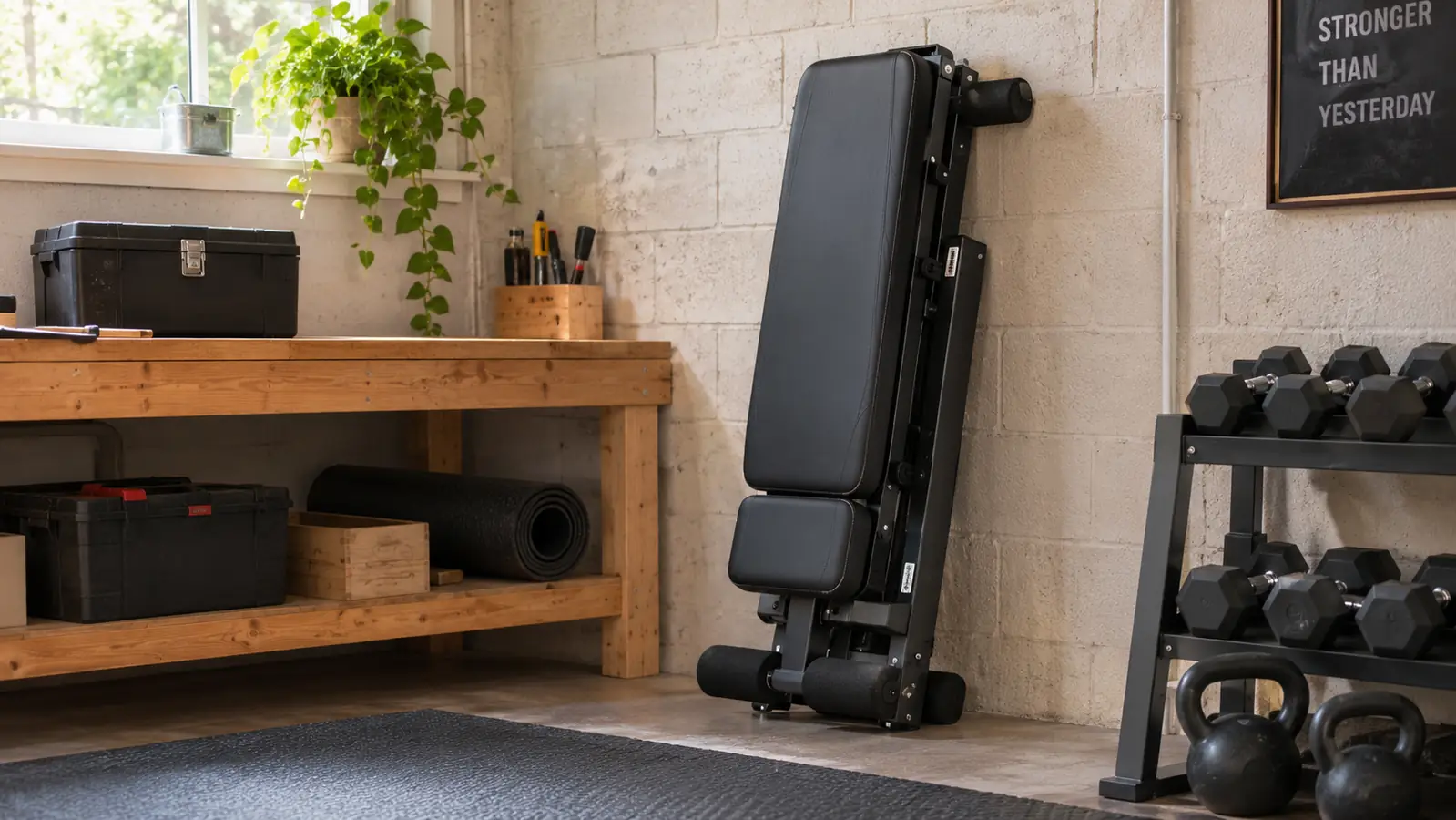
The weight of the bench is the third surprise. At 23 pounds, it is light enough to move around the basement easily, and it folds up so I can lean it against the wall when Carol wants the corner for her own routine. That is a genuine advantage. The flip side is that it is not a 100-pound monster that sits where you drop it. If you are used to a heavy commercial bench, this one will feel lighter under your hand. It has never moved on me during a set, but you should know the tradeoff going in.
The Adjustments and the 750-Pound Rating
Eight backrest positions sounds like a lot, and it is. In practice, I use four of them most weeks: flat for chest press, one position up for seated rows, a steeper angle for shoulder work, and fully upright for sitting. The 4 seat positions matter more than I expected, because they change how the bench feels under your legs when the backrest is angled. The 3 leg holder positions are for sit-ups and decline work, and they are the reason Carol and I both use the bench for ab work instead of doing crunches on the floor.
The adjustment takes about two seconds once you have the hang of it. Pull the support bar, move the backrest to the position you want, and let the bar drop back into place. That is the kind of detail that comes from a company that says it has been designing fitness equipment for 20 years. The listing also mentions spare parts availability for 7 years, which tells me they expect the bench to last long enough to need parts.
Let me be direct about the 750-pound rating. You are probably not going to use it. I am not going to use it. Very few home lifters will ever put 750 pounds on a bench. But the rating is not just a number on a sticker. It means the frame is built with reinforced triangle structures and alloy steel, and it means the bench is tested to a standard. When a bench is rated for 750 pounds, the joints and welds are built to handle forces far beyond what I will ever produce. That is why mine does not wobble, creak, or shift.
The honest caveat is that a rating is not a promise about your safety. No bench makes you strong, and no bench protects you from lifting more than your body can handle. If you are new to this, start light, learn the movements, and check with your doctor before you start a program. I say that because I mean it, not because I am covering myself. I started at 61 with light dumbbells and a lot of caution, and it is the caution that kept me coming back.
Folding, Moving, and How It Holds Up
The fold is the feature I did not expect to care about. The title says foldable, and I bought it for the adjustability, not the fold. But now I fold it almost every week. Carol does her own routine in that corner on Saturdays, and folding the bench takes about thirty seconds. It leans against the wall next to the workbench, out of the way, and I pull it back out on Monday morning. For a bench that lives in a shared space, that is a real quality-of-life thing.
Moving it is simple because it is 23 pounds. I can pick it up and carry it across the room without thinking about it. That same lightness is the only thing I would flag for someone used to a heavy commercial bench: it does not have the planted, immovable feel of a 100-pound piece of gym equipment. In practice, I have never felt it shift during a set, and the rubber mat underneath probably helps. But I would rather tell you the truth about the tradeoff than have you discover it after you buy.
I have owned this bench long enough that the new-equipment shine has worn off, so here is the honest wear report. The frame still looks like the day it arrived. No rust, no paint chips, no loose joints. The alloy steel and the reinforced triangle structure are not marketing words, they are the parts of the bench that take the load, and after months of use they have not changed. I check the bolts every few weeks out of habit, the way I used to check the table saw before a big cut, and everything is still tight.
The surface has held up too. The sweat-proof leather wipes clean, and it does not show the marks I expected it to show by now. I am not gentle with equipment, and this bench has a few scuffs on the frame from dumbbells bumping it, but no damage that matters. The one thing I cannot judge yet is the long haul. The warranty is one year, and I have owned the bench for several months, so the honest answer is that I do not know what year five looks like. I will tell you that I wish the warranty were longer. The FLYBIRD has not needed a single repair, and I do not expect one, but a longer warranty would have made me more confident.
Alternatives I Considered
I looked at flat benches before I bought this one. They are simpler, cheaper, and fine if you only ever press on a flat back. But at my age, I wanted the option to sit up for rows and shoulder work without moving to a different piece of equipment. The adjustable backrest on the FLYBIRD means one bench does the work of three positions, and in a small basement corner, that matters. I also looked at heavier folding benches with more commercial frames. They felt more planted in the store, but they weighed twice as much and cost more, and I knew I would be the one carrying them down the stairs.
In the end, the honest deciding factor was the combination of the 17.38-inch height and the 23-pound weight. The height makes it comfortable for my knee, and the weight makes it practical for my space. The 750-pound rating and the 8 backrest positions were the reasons I clicked buy, but they are not the reasons I kept it. I kept it because it is the bench I actually use five days a week, and that is the only review that matters.
What I Liked
- Rock solid under the weights I actually use, with no wobble or creak
- 8 backrest positions and 4 seat positions cover every exercise I do
- 23 pounds and folds up, so it is easy to move and store
- 17.38-inch height is genuinely easier on my stiff knee
- Sweat-proof surface wipes clean in seconds
- Built by a company with 20 years of equipment design behind it
Where It Falls Short
- One-year warranty is shorter than I would like
- The adjustment bar needs a firm pull at first
- It is a bench only: you still need dumbbells or a rack
- The pad is firm, not plush
- The 750-pound rating is overkill for most home lifters
I have never once felt this bench move under me, and I have never once loaded it anywhere near its 750-pound limit. Both of those things are true, and both of them matter.
Who This Is For
This bench is for someone like me. You are in your 60s, you train at home, and you do not need a piece of equipment that looks like it belongs in a commercial gym. You want a bench that is stable, that adjusts to the exercises you actually do, and that does not take over your basement. You want to sit down without your knee complaining and get up without using the wall. If that sounds like you, this bench is worth a hard look.
It is also for anyone with limited space. The fold and the 23-pound weight make it practical in a spare room, an apartment corner, or a basement that doubles as a workshop. And it is for people who want a bench that will not embarrass them in front of their spouse. Carol uses it as much as I do, and that was not true of the last piece of equipment I bought.
Who Should Skip It
If you are a competitive powerlifter training for a meet, buy a heavier commercial bench and do not look back. This is a home bench, built for home use, and while it is rated for 750 pounds, it is not a competition station. If you want a plush, heavily padded bench that feels like a couch, this will disappoint you. The pad is firm on purpose, and firm is not everyone's preference.
If you expect a bench to be a complete gym, skip it. You still need weights. I use dumbbells, and the bench does its job perfectly with them, but it does not come with a bar, a rack, or a spotter. And if you are not ready to actually use the thing, no bench in the world will help. I have owned equipment that became a clothes rack. This one gets used because it is easy to use, but the using part is still up to me.
If my basement sounds like yours, this is the bench I would buy again
I have owned this bench for months, and I would make the same choice tomorrow. Check today's price and see if it fits your corner of the house.
Amazon Check Today's Price on Amazon →