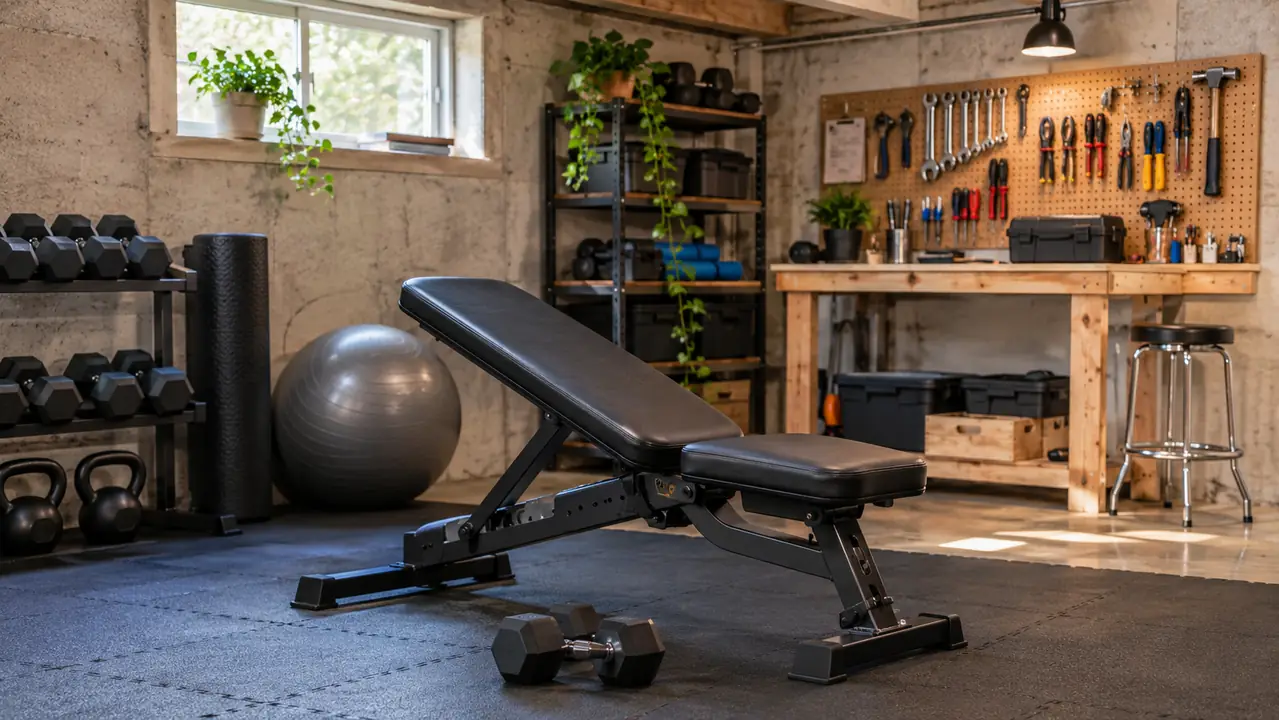
The summer I turned 61, I couldn't lift a bag of mulch out of the trunk of the car without bracing it against the bumper. Getting up off the floor after playing with my grandkids took one hand on the couch and a grunt I tried to hide. My doctor didn't mince words: I needed to strengthen my legs and my back, not just stretch them. So I cleared a corner of the basement, laid down a rubber mat, and started lifting at home three or four mornings a week. The first real piece of equipment I bought was the FLYBIRD adjustable weight bench. I've used it steadily for months now, and at 66, with a stiff left knee and a right shoulder that complains about overhead work, I think I can give you an honest picture of what this bench is like to live with.
I'll be straight with you. I didn't want to like a bench I found online. I spent thirty years teaching shop, and I know the difference between something built to last and something built to look good in a photo. The FLYBIRD surprised me. It's not fancy, and it doesn't pretend to be. It's a solid piece of steel, it adjusts the way it's supposed to, and after months of daily use it still doesn't wobble. That's the whole review in one sentence. The details below are for people who, like me, want to know what they're buying before they hand over a credit card.
The Quick Verdict
A stable, adjustable bench that earns its place in a home gym. Not perfect, but after months of daily use I'd buy it again.
Amazon Check Today's Price →A bench that holds steady for a 66-year-old who lifts three mornings a week
After months of daily use, the FLYBIRD is still the first thing I reach for in the basement. It folds flat, it adjusts in seconds, and it has never once felt shaky.
Amazon Check Today's Price on Amazon →How I've Used It
Most mornings I'm in the basement by 7:30, after coffee and before the day gets loud. I do three or four sessions a week, about half an hour each. The bench lives in the corner next to my workbench, on a rubber mat, and I set it up fresh each time. For chest work I keep the backrest flat. For my shoulders, and I have to be careful with that right one, I set it to a modest incline. For ab work I drop the backrest down and use the leg holder. Carol, my wife, uses it a couple of times a week too, usually for lighter dumbbell work and a few bodyweight exercises.
The first thing I noticed was the height. The FLYBIRD sits at 17.38 inches, which is the same height as an IPF competition bench. That sounds like something for powerlifters, but for me it means my feet stay flat on the floor when I'm on it, and I can get on and off without putting extra weight on my left knee. That matters more than I expected. A bench that's too high turns every set into a small climb. This one doesn't.
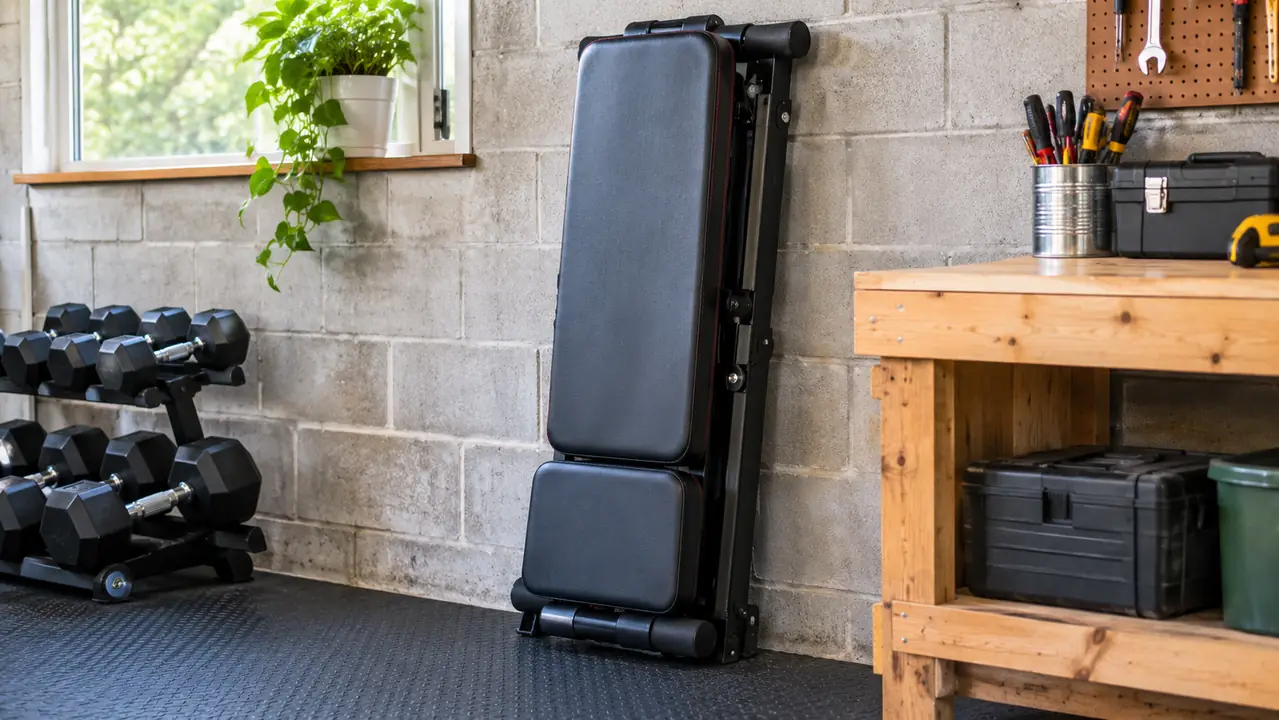
I also pay attention to how something feels after a few months, not after a few days. The sweat-proof surface wipes down easily, which matters in a basement in July. The bench is 23 pounds, so I can move it around the corner without making a production of it. And when Carol wants the corner for her own workout, I fold it and lean it against the wall. It takes about ten seconds.
I started with light dumbbells, the kind you can keep in a corner and not think about. The bench gave me a safe place to do the exercises my doctor and I talked about: chest presses, seated rows with a band, and some ab work. Over the months I've worked up to heavier dumbbells, and the bench has handled everything without a hint of trouble. That's the thing I keep coming back to. It's not the fanciest bench in the world. It's just the one that doesn't get in the way.
Stability Is the Whole Story
When you're 66, you don't bounce. A wobbly bench is not an inconvenience, it's a reason to stop lifting. So the first thing I tested on the FLYBIRD was not the adjustment mechanism. It was whether the thing moved when I moved. It doesn't. The frame is alloy steel, and the specs say it's rated for 750 pounds and tested to the ASTM standard. I am not 750 pounds and I never will be, but I have put it through months of daily use, and the bench has never shifted, rocked, or complained.
The stability comes from the design as much as the steel. FLYBIRD has been making fitness equipment for twenty years, and it shows in the details. The frame uses reinforced triangle structures, which is the same reason a good shop stool never wobbles: triangles don't fold. I can't take the frame apart to show you the welds, but I can tell you that after months of use, nothing has loosened up. I check the bench the way I used to check my tools, and it has never needed a tightening.
The first time I used it, I did something I'd never do in a store: I sat on it and rocked side to side. Not hard, just enough to see if the frame would twist. It didn't. Then I set it to an incline and pushed on the backrest with both hands. Nothing moved. I know that sounds like a strange way to test a bench, but after a lifetime around tools, I trust a test over a spec sheet. The spec sheet said 750 pounds. The test said this bench was built right.
Adjusting It Takes Seconds, Not a Toolbox
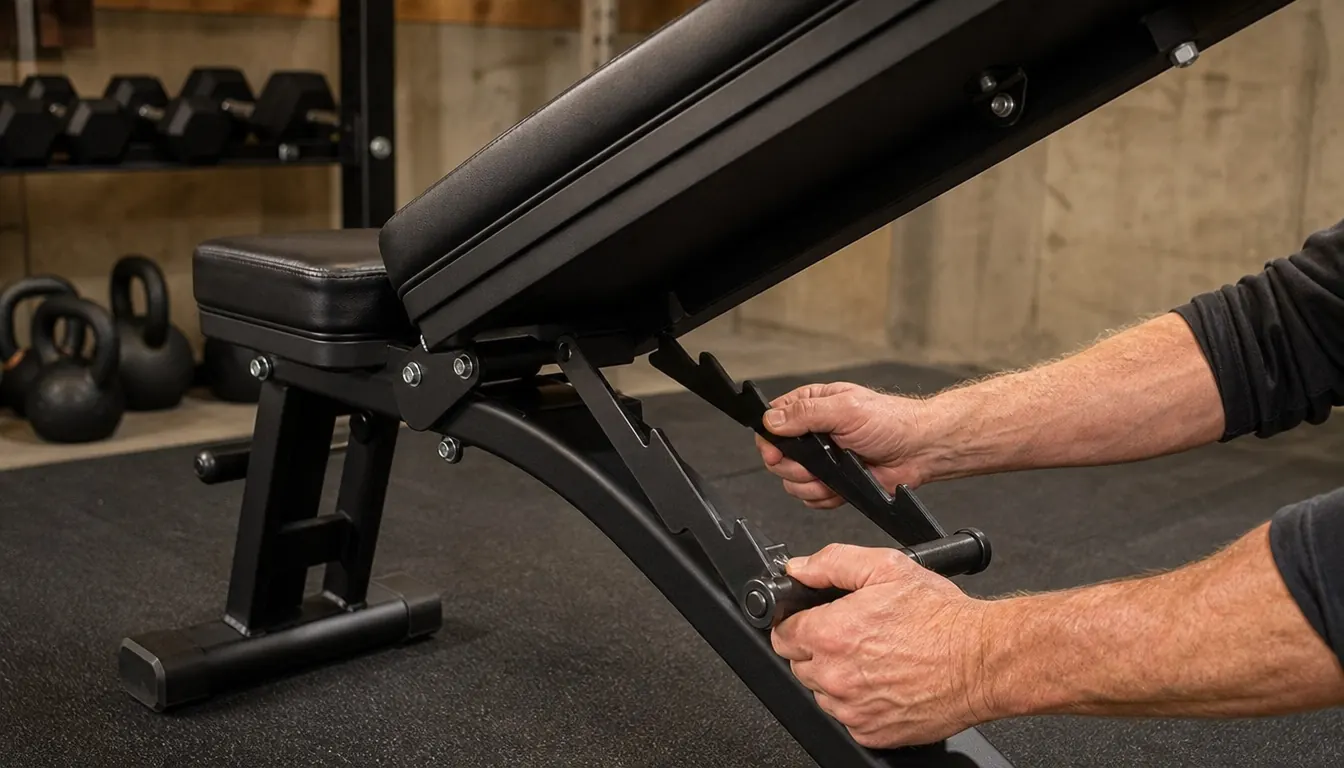
The FLYBIRD has 8 backrest positions, 4 seat positions, and 3 leg holder positions. That sounds like a lot of options, and it is, but the adjustment is simple: you pull the support bar, move the backrest where you want it, and let the bar settle back into place. No tools, no pins to line up, no swearing. I've owned benches where changing the angle meant getting out a wrench. This one takes about two seconds.
Here's how I actually use those positions. Flat for chest presses and dumbbell work. A middle incline for shoulder work, keeping the angle gentle because my right shoulder complains if I go too steep. The decline position for ab work, with my feet under the leg holder so I don't slide. And I'll be honest, I don't use all 8 backrest positions. Nobody does. But having them means I can find the angle that works for my old joints, and that's the point.
I should say a word about the leg holder, because it's easy to overlook. It has three positions, and I use it every time I do ab work with the backrest down. It keeps me from sliding toward the floor mid-set, which is exactly what a 66-year-old needs to think about. It takes a second to set, and it's one of those details that tells you the people who designed this bench have actually used one.
The Height Question, After 60
I mentioned the 17.38-inch height earlier, but it deserves its own section because it's the reason this bench works for me. At my age, the hard part of a bench press is sometimes just getting on the bench. A tall bench makes you climb. A low bench makes you fold yourself in half. The FLYBIRD sits at the IPF standard height, which is low enough that I can sit down normally and stand up normally, with my feet flat on the floor the whole time.
That might sound like a small thing. It's not. My left knee is stiff from decades on concrete shop floors, and every time I get on or off a bench, that knee does the work. With this bench, I don't have to hop or swing my leg. I just sit. And when I'm done with a set, I stand up the same way. After months of daily use, that hasn't changed and it hasn't stopped mattering.
Carol is in her 60s too, and she's not a lifter the way I am. She uses the bench a couple of times a week for light work and stretching. The height matters to her the same way it matters to me. She can sit down and stand up without thinking about it. If a bench is a thing you have to brace yourself against, you'll find reasons to skip your sessions. This one doesn't give you that excuse.
After months of daily use, the 17.38 inch height is the reason I can still get on and off this bench without grabbing the wall.
Folding It Away, and Living With It
Our basement is not a gym. It's a basement with a gym in one corner. So the fact that this bench folds matters more than any weight rating. At 23 pounds, I can carry it one-handed, and folded, it leans against the wall next to my workbench without taking up the floor. When Carol wants the space for stretching, the bench is out of the way in seconds.
The surface is described as sweat-proof leather, and I can vouch for the sweat-proof part. I wipe it down with an old rag after each session, and it still looks the same as the day it arrived. The bench is 42.3 inches wide and about 15 inches deep, which means it doesn't crowd the corner. The whole footprint is smaller than my old shop stool collection, and that's saying something.
What I'd Change, Honestly
No review is honest without the cons, so here are mine. The warranty is one year. That's not terrible, but for something you'll use daily, I'd like to see two or three. The seat is firm. I put a small pad on it for longer sessions, and that's a personal preference more than a complaint. And changing the angle means getting up off the bench. There's no lever you can pull while you're lying there. That's normal for this kind of bench, but it's worth knowing.
None of those are dealbreakers. I mention them because the internet is full of reviews that make everything sound perfect, and a bench that's perfect doesn't exist. This one is very good at being a bench. It's stable, it adjusts easily, it folds away, and it's built to a standard I can trust. The cons are small, and I'd buy it again.
What I Liked
- Rock solid after months of daily use; alloy steel frame with reinforced triangle structure
- 750 lb ASTM-tested capacity, far more than a home lifter needs
- 17.38 inch IPF standard height makes getting on and off easier on my knees
- 8 backrest, 4 seat, and 3 leg holder positions cover chest, back, abs, and arms
- Folds flat and weighs 23 lb, so it stores against a wall in seconds
- Sweat-proof surface wipes clean after every session
Where It Falls Short
- One-year warranty is shorter than I'd like for daily use
- Firm seat; I add a small pad for longer sessions
- You have to get up to change the angle
Who This Is For
If you're in your 50s, 60s, or 70s and you're starting strength training at home, this bench is a strong fit. It's for people who want something stable they can trust, who don't have a spare room for a full rack, and who want to adjust the angle without a toolbox. It's for people who, like me, need a bench that's easy to get on and off. And it's for anyone who wants to do the work without the bench being the thing they think about. If that sounds like you, this is worth a look.
Who Should Skip It
If you're planning heavy barbell work with a spotter, you're probably shopping for a power rack, not a bench. If you want a bench with a bunch of attachments and a place in a commercial gym, buy a commercial bench. And if you have health concerns, please check with your doctor before you start any new program. That's true no matter which bench you buy. This one is a home bench for people who want to train at home, and it does that job very well.
If you're over 60 and tired of the floor, this is a good place to start
It has held up for months in my basement, it folds away when Carol wants the corner, and it has never wobbled once. Check today's price on Amazon.
Amazon Check Today's Price on Amazon →