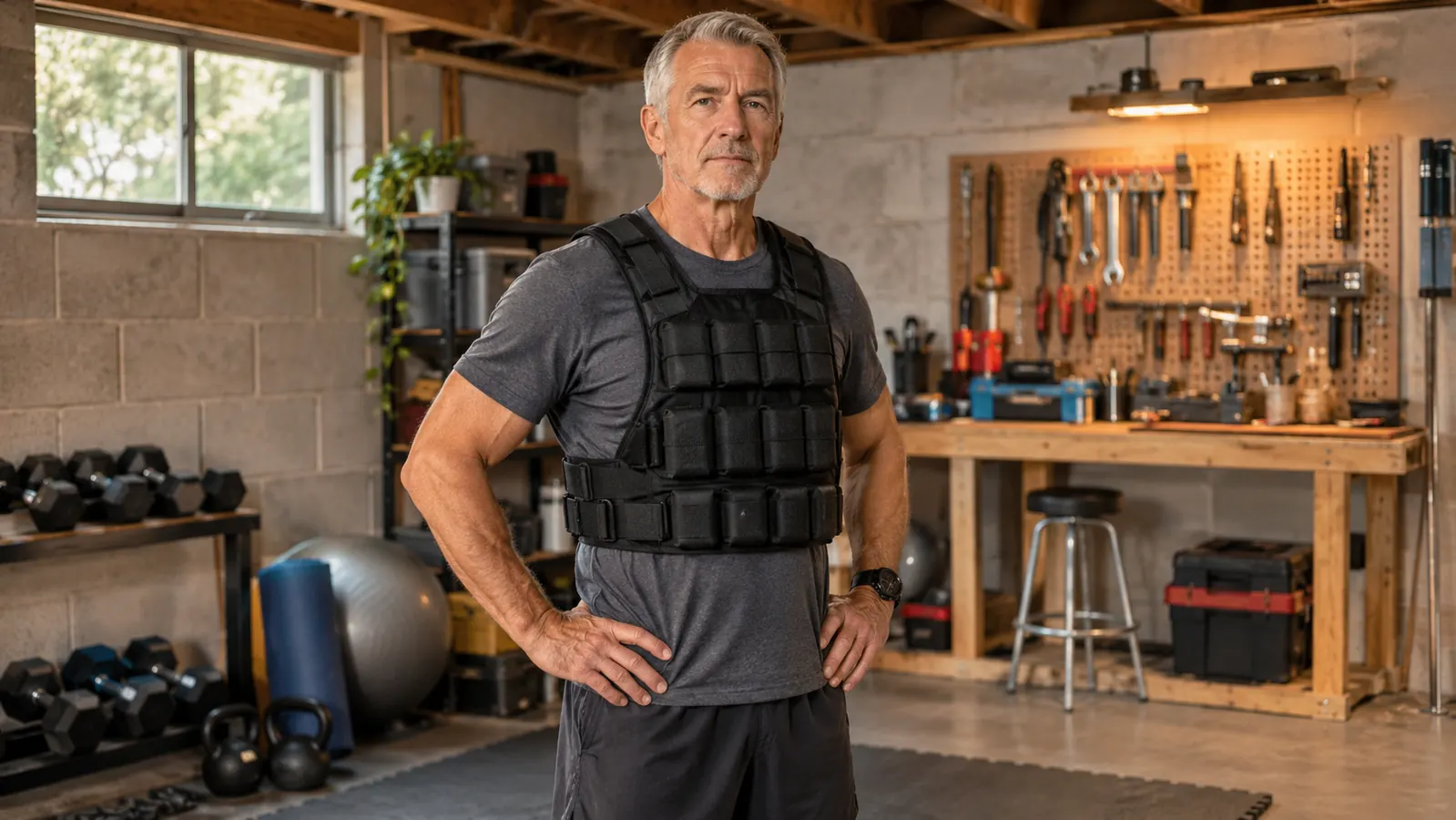
At 61, I couldn't get up off the floor after playing with my grandkids. That was the push I needed. I started lifting at home with a pair of dumbbells and a lot of doubt, and five years later I still train three or four mornings a week in a corner of my basement. Somewhere along the way I added the ZELUS weighted vest to my routine, and it has been a useful tool. But it's useful only because I started slow, followed a few rules, and never let pride pick the weight. I want to walk you through exactly how I did it, because I wish someone had laid it out for me.
A weighted vest does something simple that's hard to replace: it adds load to walking, standing, and bodyweight moves without asking your hands to hold anything. That's appealing after 60, when grip strength and shoulder comfort can limit what you can hold. The catch is that adding load to a body that's been through decades of wear needs to be done carefully. My left knee is stiff from years on concrete shop floors, and my right shoulder complains overhead. So I made rules for myself. Five of them. They apply to any vest, including the ZELUS, and they're the difference between a useful tool and a trip to the doctor.
Start with the 8 lb ZELUS and build from there
The 8 lb version is the one I started with. It's enough to feel the difference on a walk and light enough to keep good form. Check today's price and see if it fits your plan.
Amazon Check Today's Price on Amazon →Step 1: Talk to your doctor before you add weight
First rule, and I mean this: check with your doctor before you start anything. I am not a doctor and I don't play one in my basement. I talked to mine about adding load to my walks before I ordered the vest. He asked what I planned to do, I told him walking and bodyweight squats, and he gave me the green light with one instruction: start lighter than I thought I needed. I almost argued with him. I'm glad I didn't.
My instinct was to buy the 20 lb version and grow into it. That would have been a mistake. The ZELUS vest comes in sizes from 6 to 30 lb, and for most people over 60, 8 lb is plenty to start. It's enough to change the feel of a walk, not enough to change your gait. If your doctor has concerns about your balance, your blood pressure, or your joints, listen to them first. They know your history better than any online article does.
This step is not a formality. At our age, the body does not bounce back the way it did at 30. A few minutes with your doctor is cheaper than a month of recovery, and it gives you permission to train without a voice in the back of your head asking whether you should be doing this at all. That peace of mind is worth something on its own. If your doctor says go, you'll train with confidence. If your doctor says wait, you just saved yourself a costly mistake.
Step 2: Fit the vest before you do anything else
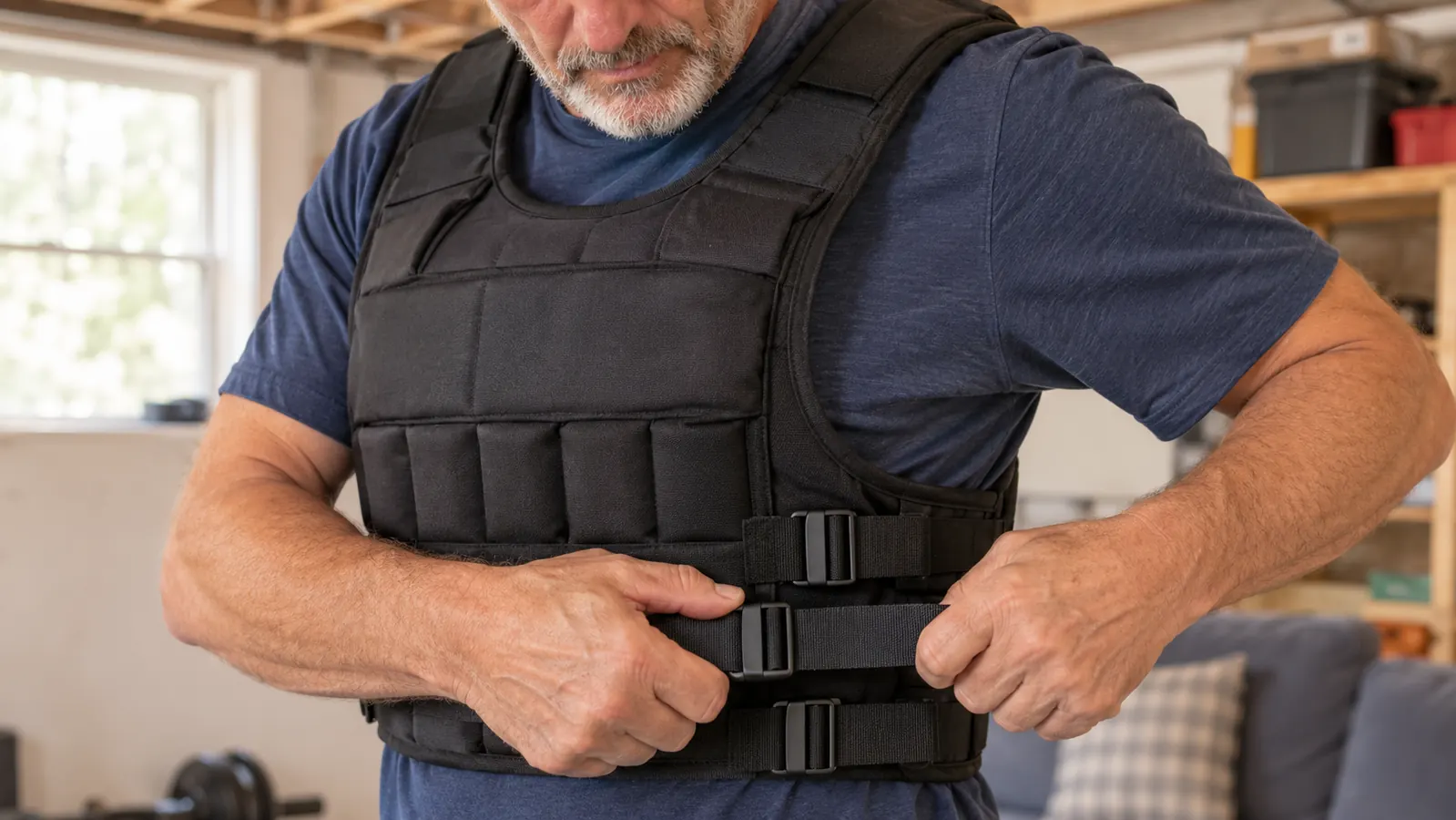
When the ZELUS arrived, the first thing I did was read the sizing and adjust the straps. It uses adjustable buckle straps, and the fit matters more than any other detail. You want it snug against your torso, not loose enough to shift around and not tight enough to restrict your breathing. I adjusted mine, walked around the basement for a few minutes, and adjusted again. The second pass was the one that felt right. Ten minutes of fiddling saved me weeks of discomfort.
Two things to check. First, the vest should sit evenly, with the load spread around your trunk rather than hanging low on your belly. Second, you should be able to take a full breath easily. If you feel it bouncing with each step, tighten the straps. If it digs into your shoulders, loosen them and try again. A vest that moves around is not just annoying, it's a fall risk, and falls are the thing we're all trying to avoid at this age. I check the fit every few weeks, because the vest beds in and the straps stretch a little. A thirty second check before I start saves me from noticing mid-walk that something has shifted.
The vest is made with iron sand, SBR, and spandex, so it has some give, but the buckles do the real work of keeping it in place. I also found the arm pockets useful on the days I walk outdoors. Phone and keys go in there, and the 360 degree reflective strips help with visibility when I'm on the road. Both are small details, but they add up, and they're part of why I reach for this vest instead of the one I almost bought.
Step 3: Walk first, then add movement
My first week with the 8 lb vest, I did nothing but walk. Ten to fifteen minutes around the block, at a pace where I could still hold a conversation. The vest makes you aware of your posture, because slouching with extra weight feels wrong immediately. I used that as a cue: shoulders back, ribs down, easy steps. Walking is the perfect first exercise with a vest because it's familiar. You're not learning a new movement and a new load at the same time.
After a week of walking, I added bodyweight squats. I held the workbench for balance at first, because my stiff left knee does not love deep bends. The vest adds load to the movement without asking my hands to hold dumbbells, which my right shoulder appreciates. Step-ups onto the bottom step of the basement stairs came next. Keep the movements simple and controlled, and stop the set when your form starts to slip. One good rep is better than five sloppy ones.
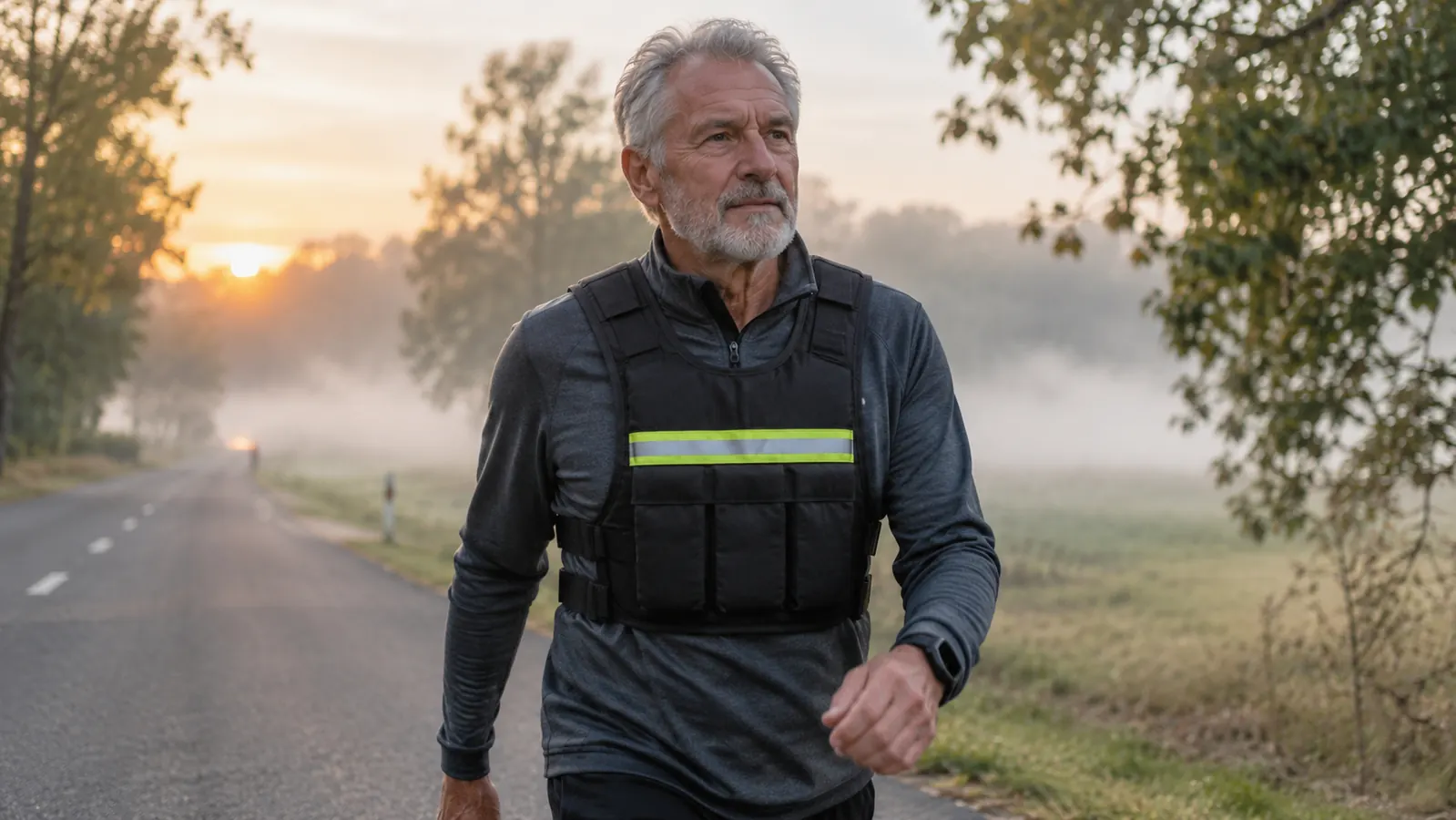
If you plan to walk outside, the reflective stripes on the ZELUS are genuinely useful. I do most of my training in the basement, but on mild mornings I take the vest out on the road, and being visible at dawn is not a small thing at our age. Cars don't expect to see a man in a vest walking at 6:30 in the morning. Give them every chance to spot you.
Step 4: Add time before you add weight
The rule I followed: master the time before you add the weight. Stay at 8 lb until you can walk twenty to thirty minutes without your breathing changing or your joints complaining. Then, and only then, consider moving up to 12 lb. The ZELUS line goes 6, 8, 12, 16, 20, 25, and 30 lb, so there's a natural next step, but there's no prize for getting there fast. The prize is still being able to train next year. I tell myself that every time I think about ordering the 16 lb version.
I wore the vest two or three times a week at first, never on back-to-back days. Rest days are when the body adapts, and at 66 I need more of them than I used to. The vest is a tool for making the work harder, not for making every single day harder. If you wake up the morning after a vest session and your joints feel angry, that's a signal, not a failure. Take the extra rest day.
One more thing: I don't wear the vest for daily errands or around the house. It's training gear, not a fashion statement. Keeping it for dedicated sessions means I'm paying attention when I wear it, and paying attention is the whole point. The moment a vest becomes background noise is the moment you stop noticing that something feels off, and that's exactly when injuries happen.
Step 5: Listen to your body and keep a log
This is the rule that has kept me injury-free for five years: if something hurts sharp, I stop. Not push through, not walk it off. Sharp pain is information. My left knee has a dull ache after heavy squat days and that's fine, but if it ever turned sharp I would back off for a week. Same for my right shoulder. The vest should make you work harder, not make you hurt. That one sentence has saved me more times than any piece of equipment.
I keep a simple log in a notebook on the workbench. Date, what I did, how it felt. It takes thirty seconds and it catches problems early. Last spring, I noticed my lower back was tired after every vest session for two weeks straight. The log showed it, I took a week off, and the problem went away. Without the log I would have kept going and probably hurt myself. You don't need an app for this. A notebook and a pen work fine.
Your body after 60 sends quieter signals than it used to. Write them down. If you feel dizzy, short of breath in a way that's new, or pressure in your chest, take the vest off and call your doctor. That's not dramatic, that's just smart. The vest will still be there tomorrow. Your health needs to be there for a lot longer. There is no workout worth a trip to the emergency room.
What Else Helps
A few things made the vest work better for me. Good shoes with real grip, because extra weight changes how your feet land. A rubber mat in my basement corner, so I'm not standing on concrete. A warm-up of five minutes of easy movement before I put the vest on, and a cool-down after. Carol sometimes joins me, and having her there keeps me honest about form. None of these are complicated. They just make the whole thing safer and more pleasant.
If you're new to strength training entirely, I'd spend a few months on bodyweight work before adding a vest at all. The vest is a progression, not a starting point. Walk, squat, get off the floor comfortably, and then load it up. And when you do load it up, start with the lightest setting that still makes you notice it. For most people over 60 that's the 8 lb version. For some it's the 6 lb. Both are fine, and neither is worth rushing past.
One more thing that helped: I stopped comparing myself to the people in the product photos. The ZELUS is marketed to fitness enthusiasts of all ages, and the pictures show younger bodies doing harder movements. That's fine. I'm not trying to impress anyone in my basement. I'm trying to be able to get up off the floor when my grandkids visit. That's the whole goal, and the vest serves it.
Eight pounds sounds like nothing until you've walked a mile with it. Then it feels exactly like eight pounds, in the best way.
I'm 66 years old, I have a stiff left knee and a right shoulder that complains when I reach overhead, and I've been training with the ZELUS vest for long enough to trust it. The rules above are the ones I actually follow, not the ones I wish I followed. Start light, fit it properly, walk first, add time before weight, and listen to your body. Do that, and the vest becomes a tool you'll still be using years from now. Skip those rules, and it becomes a coat rack with a weight problem.
Eight pounds changed my morning walks. It can change yours too.
The ZELUS 8 lb vest is where I started and where I'd tell anyone over 60 to start. Check today's price on Amazon and talk to your doctor before you begin.
Amazon Check Today's Price on Amazon →