
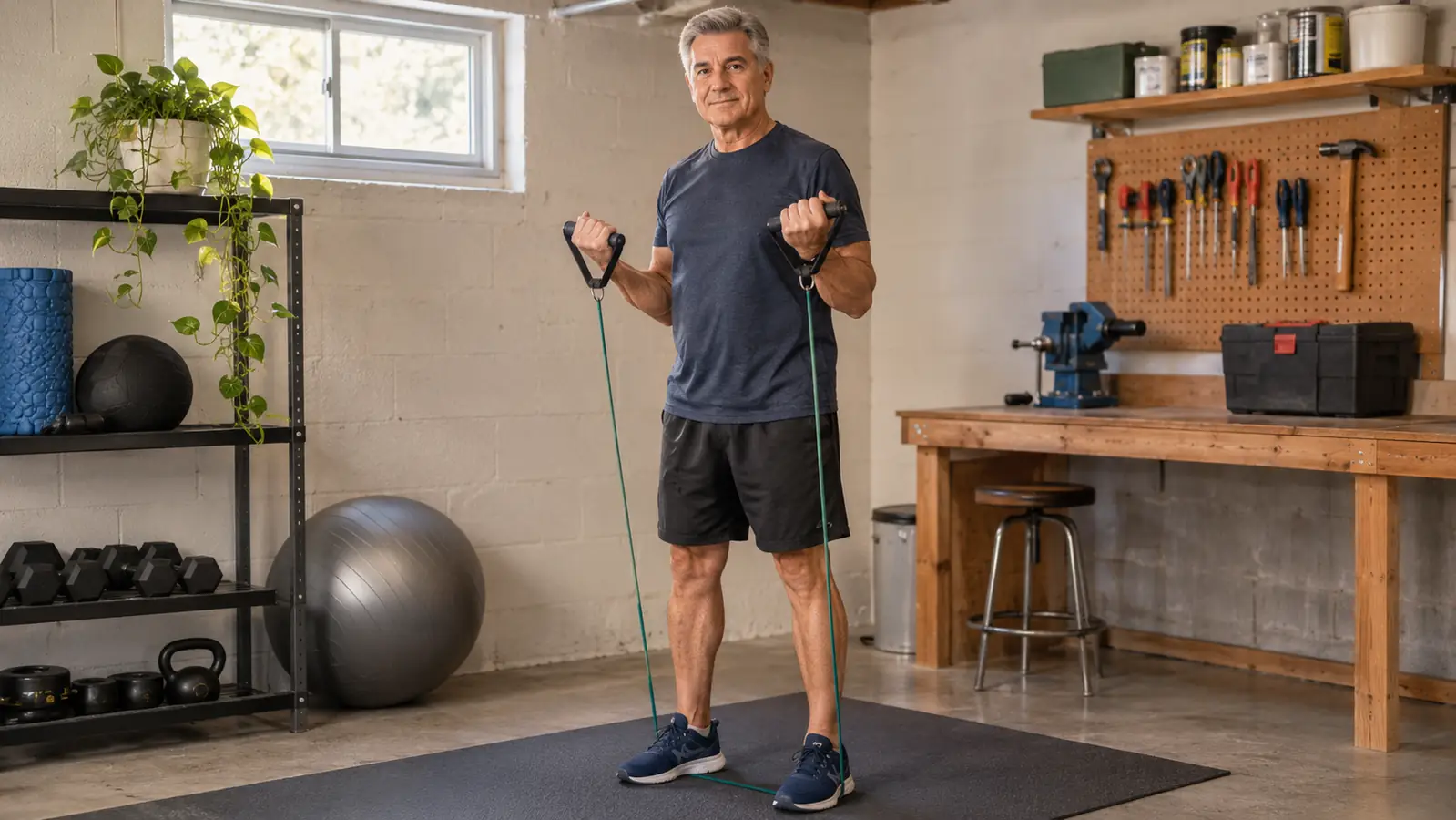
I will be honest with you. I did not expect to like the WHATAFIT resistance bands as much as I do. I bought them for a simple reason: my right shoulder complains when I press a heavy barbell overhead, and my left knee has been stiff for years. I wanted something that would let me keep training without making either one worse. These bands have been part of my basement routine for months now, and they have earned a permanent spot next to my workbench.
Before I go any further, let me say this: I am 66, I am not a trainer, and I am not giving medical advice. If you have an injury or a condition, check with your doctor before you start any new program. What follows is one retired shop teacher's honest experience with a piece of equipment that takes up almost no room and has become the most used thing in my basement.
The Quick Verdict
A practical, portable resistance band set that does more than I expected, with a few honest limits you should know about before buying.
Amazon Check Today's Price →A full home gym that fits in a carry bag
The WHATAFIT set includes five tubes, two cushioned handles, two ankle straps, a door anchor, a carry bag and a user manual. If you want to see today's price and current reviews, the link below goes straight to the Amazon listing.
Amazon Check Today's Price on Amazon →How I've Used It
Three or four mornings a week, I carry the bag downstairs, unzip it, and set up in the corner of my basement where the rubber mat is. The whole setup takes about two minutes. I use the door anchor for rows and presses, the handles for curls and shoulder work, and the ankle straps for leg movements that my stiff knee tolerates better than squats.
The five tubes are rated at 10, 20, 30, 40 and 50 lb. I started with the 20 and 30 lb tubes for most upper body work and the 10 lb tube for my shoulder. As the weeks went by, I added the 40 lb tube to rows and presses. The tubes can be used alone or stacked together, so the resistance range is wider than it looks. I have even combined the 30 and 40 lb tubes for a heavier row when I wanted a challenge.
I keep a small notebook on the workbench. I write down how many reps I did and how the movement felt. That has been more useful than I expected, because bands do not tell you your weight the way a barbell does. The notebook is my progress tracker. It also keeps me honest. On days when I feel like skipping, I look at last week's numbers and remember why I started.
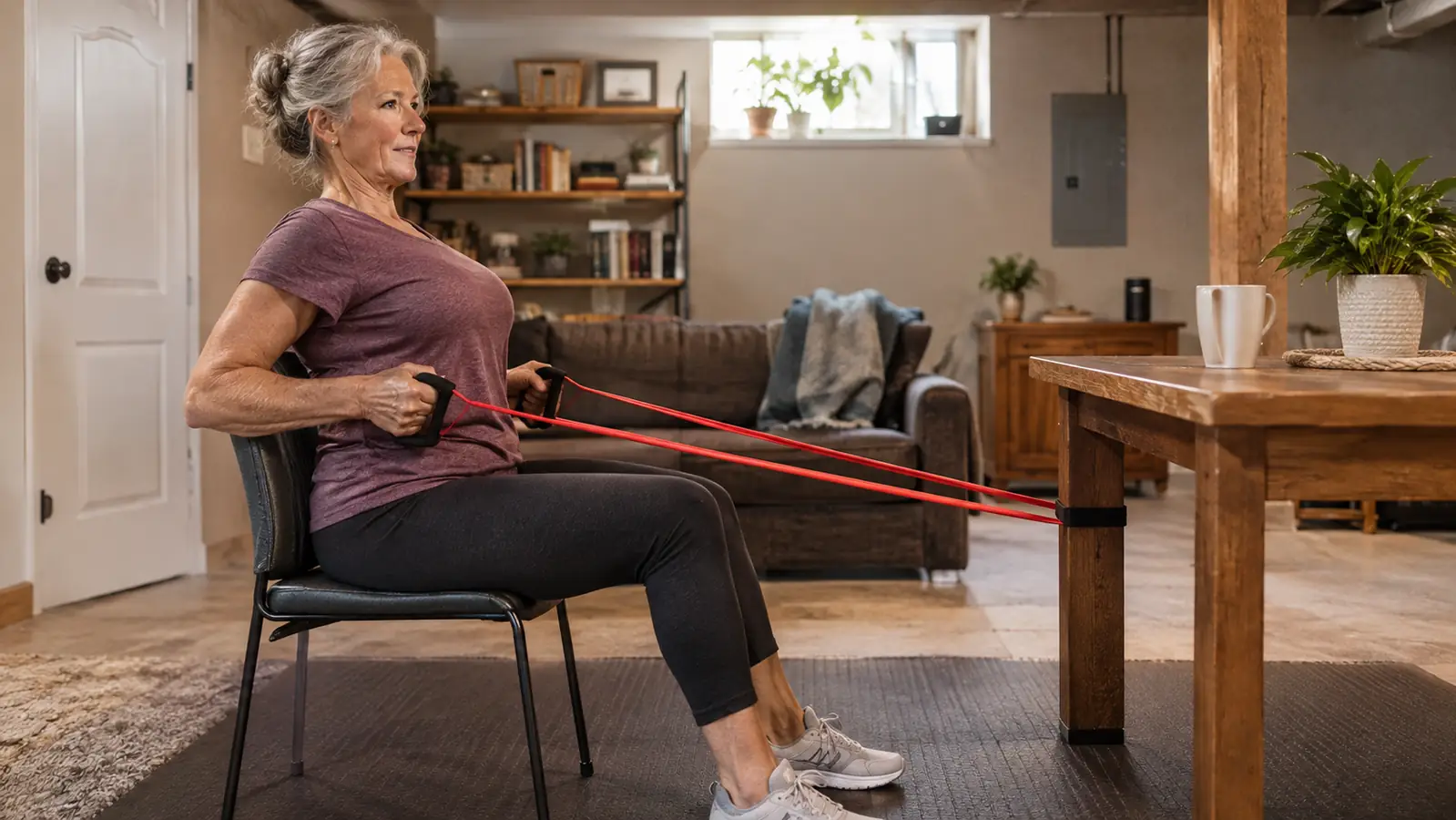
Carol has used them too. She is not a lifter and she has never liked gyms, but she will sit on the edge of the workbench and do rows with the light tube while I work. That alone was worth the purchase. It is hard to put a number on having your wife join you for ten minutes of exercise before breakfast.
What Nobody Tells You Before You Buy
Here is the part most reviews skip. Resistance bands do not feel like free weights. The tension gets harder as the band stretches, so the first part of a movement is easy and the last part is hard. That is not a flaw. It is just different. If you are used to a barbell, the first few workouts will feel strange. Your muscles will still work, but your brain has to learn a new rhythm.
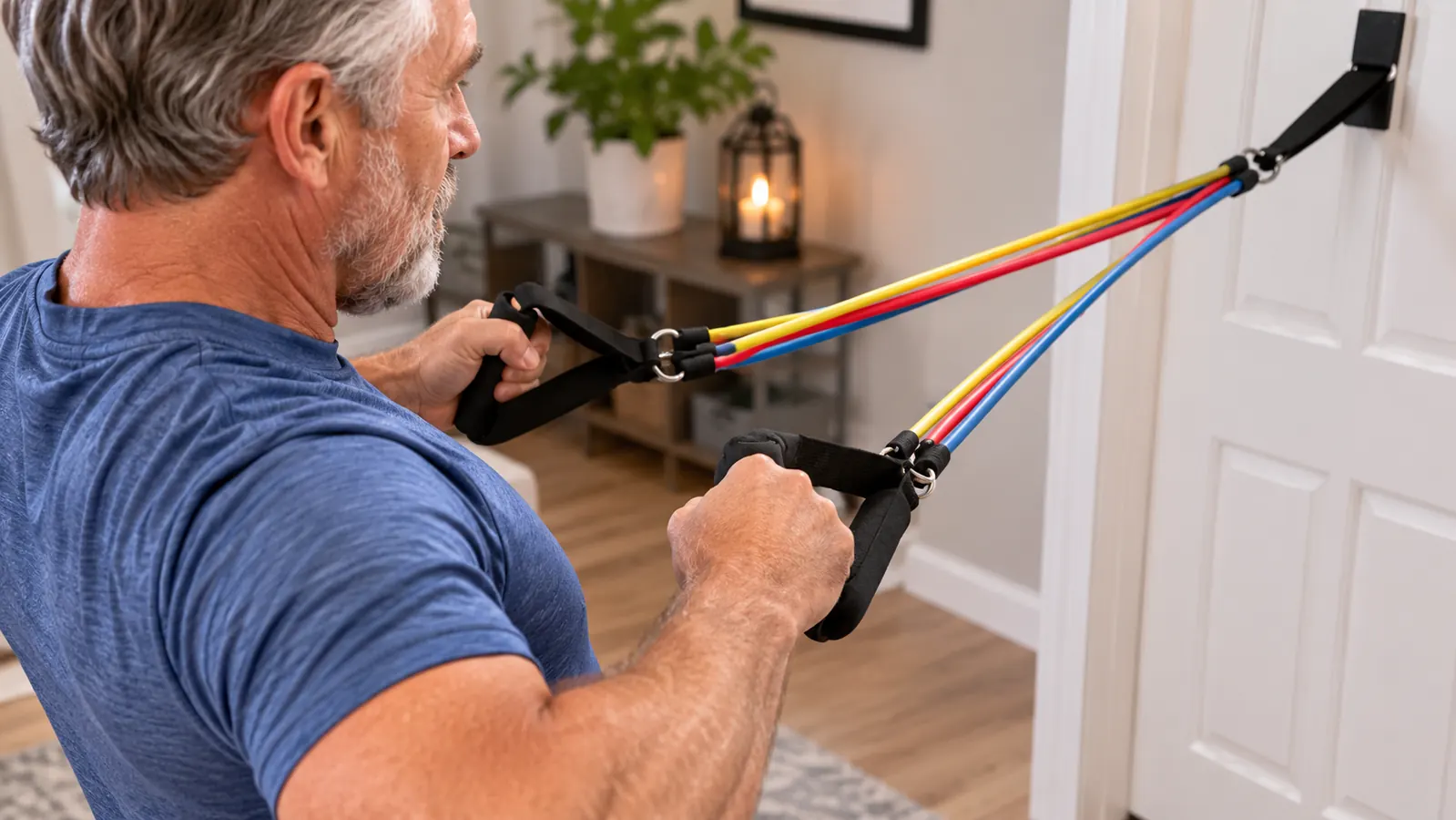
The second thing nobody tells you is that the door anchor depends on your door. I have solid interior doors in my house, and the anchor holds fine. A friend of mine has hollow core doors, and the anchor slipped on him. You can use it on a sturdy door or a banister, but you should test it before you trust it. The first time I used it, I pulled slowly for a few reps before I put any real force into it.
The third thing is that measuring progress is less direct. With a dumbbell, you know you moved from 20 to 25 lb. With bands, you have to pay attention to how many reps you complete and how hard the last few feel. That is why I keep the notebook. It is not complicated. I just write the date, the exercise, the tube, and the reps. After a few weeks, the pattern is clear.
One more thing: the handles are cushioned, but if you grip them hard for a long set, your hands will still feel it. That is normal. It is not a reason to avoid the set. It is a reason to pace yourself and let your grip recover between exercises.
The Bands Themselves: What's in the Bag
The WHATAFIT set comes with five color-coded tubes, two cushioned handles, two ankle straps, one door anchor, one carry bag and a user manual. The whole thing weighs about 2 pounds and the bag is small enough to toss in a suitcase. I have taken it on a weekend trip and used it in a hotel room. It took me longer to find the hotel gym than it did to set up the bands in my room.
The tubes are rated at 10, 20, 30, 40 and 50 lb, and they stack. That means you can combine the 10 and 20 for 30 lb, or add the 40 to the 30 for 70 lb. The range covers everything I need at my age and my level. The two ankle straps are useful for leg work, and the door anchor turns any door into a cable station. I use the door anchor for rows and presses, and I use the handles for curls and shoulder work.
The carry bag is simple, not fancy. It keeps the tubes from tangling if you roll them properly, and the user manual shows a few basic exercises. I did not need the manual for long, but it was nice to have on the first day. The whole set is also easy to clean. I just wipe the handles down with a damp cloth after a sweaty session.
The 2 year limited warranty is another thing I did not expect on a set of bands. I have not needed it, and I hope I never do, but it tells me the company stands behind the product. That matters more to me now than it did when I was younger.
What It's Like to Train With Them
I start with a warmup using the 10 lb tube. Then I move to rows, presses, curls and shoulder work. The cushioned handles are comfortable enough for most sets. The ankle straps let me do leg extensions and kickbacks without putting weight on my knee. That has been the biggest win for me. I can train my legs without the grinding feeling that squats sometimes cause.
The movements are smooth and quiet. There is no clanging, no dropping, no noise that wakes Carol upstairs. I can train at 6 in the morning without bothering anyone. That alone is worth a lot to a guy who likes to get his workout done before breakfast. In the summer, I have even taken the bands out to the porch and trained in the morning air.
The tension curve takes some getting used to. On a row, the band is easiest at the start and hardest at the end, which is actually a decent match for how a row should feel. On a press, it means the lockout is the hardest part. I have learned to slow down at the end of each rep instead of rushing through it. That has made me more careful about form, which is probably a good thing at my age.
I also use the bands for daily stretching. The recommended uses list daily stretching and workout, and I have found the light tube is perfect for loosening up my shoulder before I lift. It has become part of my morning routine. Ten minutes of stretching with the light tube has done more for my shoulder than I expected.
The First Month: What Actually Happened
The first week was humbling. I used the 20 lb tube for rows and it felt easy, so I moved to the 30 lb tube and got a real workout. My shoulder handled the 10 lb tube fine, which surprised me. The second week, I added the ankle straps and discovered my legs were weaker than I thought. The third week, I started stacking tubes and keeping better notes. By the fourth week, I had a routine I actually looked forward to.
The biggest surprise was how much my knee appreciated the change. I have a stiff left knee from decades on concrete shop floors, and squats with a barbell always made it grumble. The band work lets me train my legs without that grinding feeling. I am not saying the bands fixed anything. I am saying they let me keep moving in a way that does not hurt.
The other surprise was consistency. Because the setup is so fast, I stopped making excuses. There is no drive to the gym, no waiting for a bench, no cold car in January. I walk downstairs, unzip the bag, and start. That ease is probably the real reason these bands have worked for me.
Where It Shines and Where It Doesn't
Where it shines: portability, value, and joint-friendly resistance. I can do a full body workout in a corner of my basement, pack the whole thing in a bag, and take it anywhere. The resistance is smooth and I never have to worry about dropping a weight on my foot. For someone with a stiff knee and a cranky shoulder, that is a big deal.
Where it does not shine: if you are chasing heavy progressive overload with a barbell, bands are not a replacement. They are a complement. I still use a pair of dumbbells for some things, and I would not pretend the bands give me the same feeling as a loaded barbell on my back. But for a guy in his 60s who wants to stay strong without beating up his joints, they do the job.
The other limit is that switching tubes takes a few seconds. You clip and unclip, and if you are moving between exercises quickly, it adds a little time. I do not mind it. I use the pause to catch my breath and write down my reps. But if you are the kind of person who wants to fly through a circuit with no breaks, you will notice the extra steps.
There is also a learning curve with the ankle straps. They take a moment to get snug, and if you are not used to them, they can feel awkward at first. Give it a week. Once you figure out the right tightness, they stay put and the leg exercises feel natural.
What I Liked
- Five stackable tubes from 10 to 50 lb cover a wide range
- Includes handles, ankle straps, door anchor, carry bag and manual
- Easy to set up in any room, and quiet enough for early mornings
- Joint-friendly resistance that has been gentle on my knee and shoulder
- Light and portable enough to take on a trip
Where It Falls Short
- Bands do not feel like free weights, and the tension curve takes getting used to
- Door anchor may slip on hollow core doors, so test it first
- Switching tubes between exercises adds a little time
- Progress is harder to measure without keeping notes
- Not a replacement for heavy barbell work if that is your goal
Five tubes from 10 to 50 lb, a door anchor, and two minutes of setup. That is the whole gym, and it fits in a bag.
Who This Is For
This set is for someone like me: an older adult who wants to stay strong, keep moving, and not beat up their joints. It is for people who do not have room for a rack of dumbbells or a barbell. It is for travelers who want a workout in a hotel room. It is for anyone who wants to start strength training at home without a big investment and without a gym membership.
If you are willing to keep notes, start light, and be patient with the tension curve, the WHATAFIT bands will give you a lot of value. I have used mine several times a week for months, and they still look and work like they did on day one. The 2 year limited warranty is a nice safety net, though I have not needed it.
I would also recommend them to someone who has not lifted in years and is nervous about starting. There is something less intimidating about a band than a barbell. You can start with the light tube, do ten minutes, and feel like you accomplished something. That feeling matters when you are trying to build a habit.
Who Should Skip It
If your goal is to lift as heavy as possible and build maximal strength with a barbell, skip this and find a gym. If you have hollow core doors and no other anchor point, you may find the door anchor frustrating. If you prefer the feel of free weights and will not adapt to the tension curve, bands will sit in the bag.
And if you have an injury or a health condition, do not take my word for anything. Check with your doctor first. That is not a disclaimer I am adding for show. It is the same thing I would tell a neighbor on my porch. Your body is different from mine, and only a professional who knows your history can tell you what is safe.
I would also say this: if you are the kind of person who needs a gym to stay motivated, the bands will not fix that. They are a tool, not a coach. You still have to show up, do the work, and write down your reps. If you can do that, they will treat you well.
The Bottom Line
So here is my honest bottom line. The WHATAFIT resistance bands are not magic. They will not turn you into a bodybuilder, and they will not replace a heavy barbell if that is what you want. What they will do is give you a simple, quiet, portable way to strength train at home, with enough resistance range to keep you challenged for a long time.
For me, that has been enough. I am 66, I have a stiff knee and a cranky shoulder, and I have stuck with these bands for months. That is the best review I can give any piece of equipment. It is not the fanciest thing in my basement. It is the thing I actually use.
The honest bottom line
The WHATAFIT resistance bands are a practical, portable way to strength train at home, with real limits that I have spelled out above. If that sounds like a fit for your routine, the link below shows today's price and the current customer reviews.
Amazon Check Today's Price on Amazon →